
The Thirty-Year Premise That Just Evaporated
For more than three decades, the global business playbook had a well-worn chapter on efficiency: if a task is definable, repeatable, and can be monitored from afar, someone in a lower-cost country can probably do it cheaper. This simple principle, known as labor arbitrage, built a multi-trillion-dollar global outsourcing industry. It powered call centers in Manila, software development hubs in Bangalore, and back-office processing in Krakow. It was, for a long time, the smartest financial move a company could make.
Then, generative AI went mainstream. And according to a stunning new analysis from the Harvard Business Review, this technology isn’t just another tool for incremental improvement. It’s an existential threat to the very foundation of the outsourcing model as we know it.
In a piece slated for its July-August 2026 issue, author Abhinav Agrawal argues that the core logic of labor arbitrage is collapsing. The routine, rules-based tasks that were once prime candidates for offshoring are now prime candidates for automation. The question is no longer, „Who can we pay less to do this?“ but rather, „Why pay a person at all when an algorithm can do it for pennies, instantly, and on-premise?“
This isn’t a distant, futuristic scenario. The ground is already shifting. A recent study published in Management Science found that demand for roles susceptible to automation, like copywriting, plummeted by 30% after the introduction of generative AI tools. Even more telling for the outsourcing giants, demand in software development dropped by 20%. The work isn’t just moving; in some cases, it’s disappearing into the machine.
From Headcounts to Outcomes: The Great Contract Rewrite
Imagine you’re a Chief Technology Officer. For the past decade, your relationship with your primary IT services partner has been governed by a thick contract centered on one key metric: headcount. You contracted for 500 full-time equivalents (FTEs) at a blended hourly rate. Your monthly invoice was a simple, if massive, calculation based on the number of people assigned to your account. This was the commercial model of the industry: buying human time in bulk.
Today, that model is beginning to look profoundly naive. Why would you pay for 500 developers when a team of 100, augmented by sophisticated AI co-pilots, can deliver the same output, or more? Why pay for a team to handle level-one support tickets when an AI-powered chatbot can resolve 80% of them with higher customer satisfaction?
This is the crux of the shift Agrawal identifies in HBR. The industry is moving away from long-term, headcount-based contracts and toward flexible, outcome-based pricing. You’re no longer buying a developer’s time; you’re buying a completed software module. You’re not paying for a support agent; you’re paying for a resolved customer issue. This fundamentally rewires the relationship between client and vendor.
This isn’t just a theoretical shift. Legal and industry analysts are seeing it in the trenches right now. An analysis from law firm JD Supra in May 2026 noted that companies are aggressively re-evaluating core contract clauses—pricing, intellectual property rights (a huge one: who owns the AI-generated code?), and liability frameworks. Similarly, a March 2026 report from the SSONetwork described how AI is transforming „every phase of the outsourcing lifecycle,“ from initial vendor selection to governance and renewal.
The New Negotiation Table
The conversations are changing. Old negotiations were about reducing the hourly rate by a few percentage points. New negotiations are about:
- Productivity Gains: „If we adopt your AI platform, we expect a 40% reduction in the overall contract value for the same scope of work. How will you deliver that?“
- IP Ownership: „If your AI tools are used to write code for our proprietary application, who owns that code? How do we ensure it isn’t trained on our data and then used for a competitor?“
- Skills, Not Bodies: „We don’t need 100 junior Java developers anymore. We need five expert data engineers, three AI compliance specialists, and two prompt engineering leads. Your value is no longer in your scale, but in your niche expertise.“
The Strategic Inflection Point: Re-Shore, Re-Skill, or Re-Partner?
The HBR article wisely cautions against viewing this moment as a simple cost-cutting opportunity. It’s a strategic inflection point that forces a fundamental re-evaluation of a question every leader must ask: What work should we do ourselves, and what should we buy from others?
For decades, the answer was driven by cost. Now, it’s driven by capability and strategic value. As the cost advantage of offshoring evaporates, two primary paths emerge for businesses.
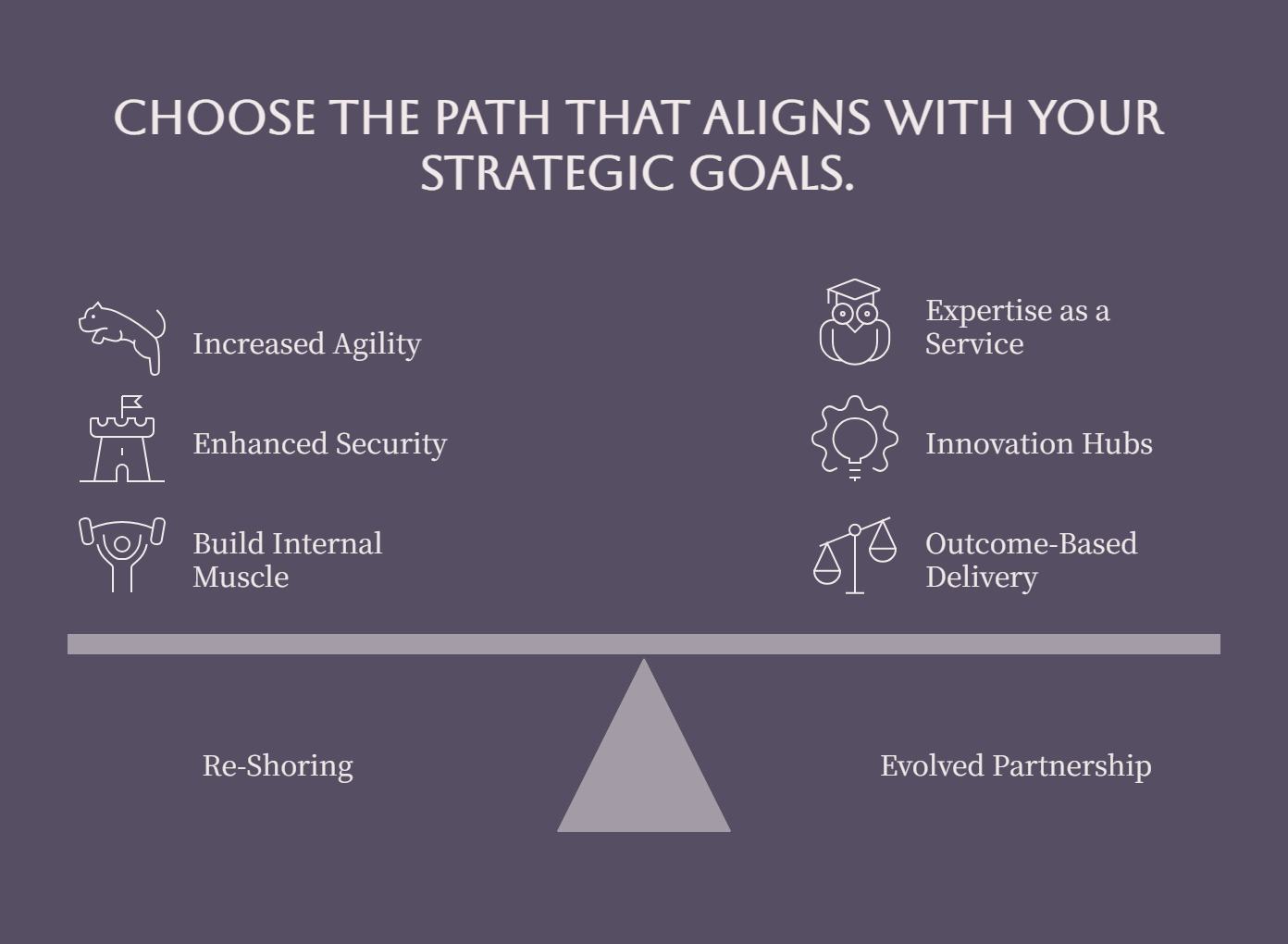
Path 1: The Great Re-Shoring
The first option is to bring the work back in-house. If AI tools can make a small, local team as productive as a large offshore one, the logic for outsourcing weakens considerably. Why deal with time zones, cultural differences, and complex vendor management if you don’t have to? By bringing the work back, companies can:
- Increase Agility: An in-house team can iterate faster and be more responsive to business needs.
- Build Internal Muscle: You develop critical, in-house expertise in AI implementation and management, which will be a core competitive advantage for the next decade.
- Enhance Security and Control: Keeping sensitive data and proprietary processes within your own walls reduces risk.
Path 2: The Evolved Partnership
The second path isn’t to abandon outsourcing, but to radically change what you’re looking for in a partner. The commodity providers who simply offered cheap labor will become obsolete. The new breed of strategic partner will offer something different:
- Expertise as a Service: They won’t sell you developers; they’ll sell you access to world-class expertise in AI model fine-tuning, data governance, and regulatory compliance.
- Outcome-Based Delivery: They will take on the risk, committing to deliver a specific business outcome—like a 30% reduction in customer service costs or a 50% faster software development lifecycle—for a fixed price.
- Innovation Hubs: They will act as your external R&D, constantly scanning the horizon for new AI technologies and figuring out how to integrate them into your business processes.
As a 2026 Slalom piece in HBR pointed out, the ultimate goal of AI isn’t just to eliminate jobs. It’s to „automate routine tasks and free up humans to focus more on creativity, critical thinking, and problem-solving.“ The right partner will help you achieve this human-centric goal, not just replace human costs with server costs.
A Moment of Reckoning for the Titans
The implications for the giants of the IT services world—particularly the Indian firms that perfected the labor arbitrage model—are profound and immediate. Their entire business was built on a premium for managing vast armies of offshore talent. As AI automates a growing slice of the work those armies performed, that premium is eroding.
Clients are coming to the table armed with data, demanding new commercial models that pass the AI-driven efficiency gains directly to them. The vendors that survive and thrive will be those that pivot from being managers of people to being orchestrators of technology. They must transform their workforce, re-skilling thousands of employees from routine coders into AI strategists, data scientists, and business process consultants.
The era of winning a deal because you had more people in a low-cost location is over. The future belongs to those who can deliver the most value, the smartest insights, and the best outcomes, regardless of where their people—or their algorithms—are located.
This isn’t just another trend. It’s a seismic shift. For any leader who has an outsourcing contract in place, the message is clear: the assumptions that contract was built on are likely no longer valid. It’s time to re-read the fine print and start asking some very different questions.