
The Blindsiding Resignation
It’s a Tuesday morning. You’re sipping your coffee, reviewing your daily stand-up notes, when the calendar notification pops up: “Catch-up with Sarah.” You smile. Sarah is your rockstar, the one who always goes the extra mile, the one you can count on to mentor new hires and untangle the gnarliest technical problems. You assume she wants to discuss her latest project.
Fifteen minutes later, your world has tilted on its axis. Sarah, your star performer, has just given her two weeks‘ notice. She’s polite, professional, and offers all the standard lines about a “new opportunity she couldn’t pass up.” You’re left stunned, running through your recent interactions. There were no signs. No complaints. No dramatic confrontations. Everything seemed… fine.
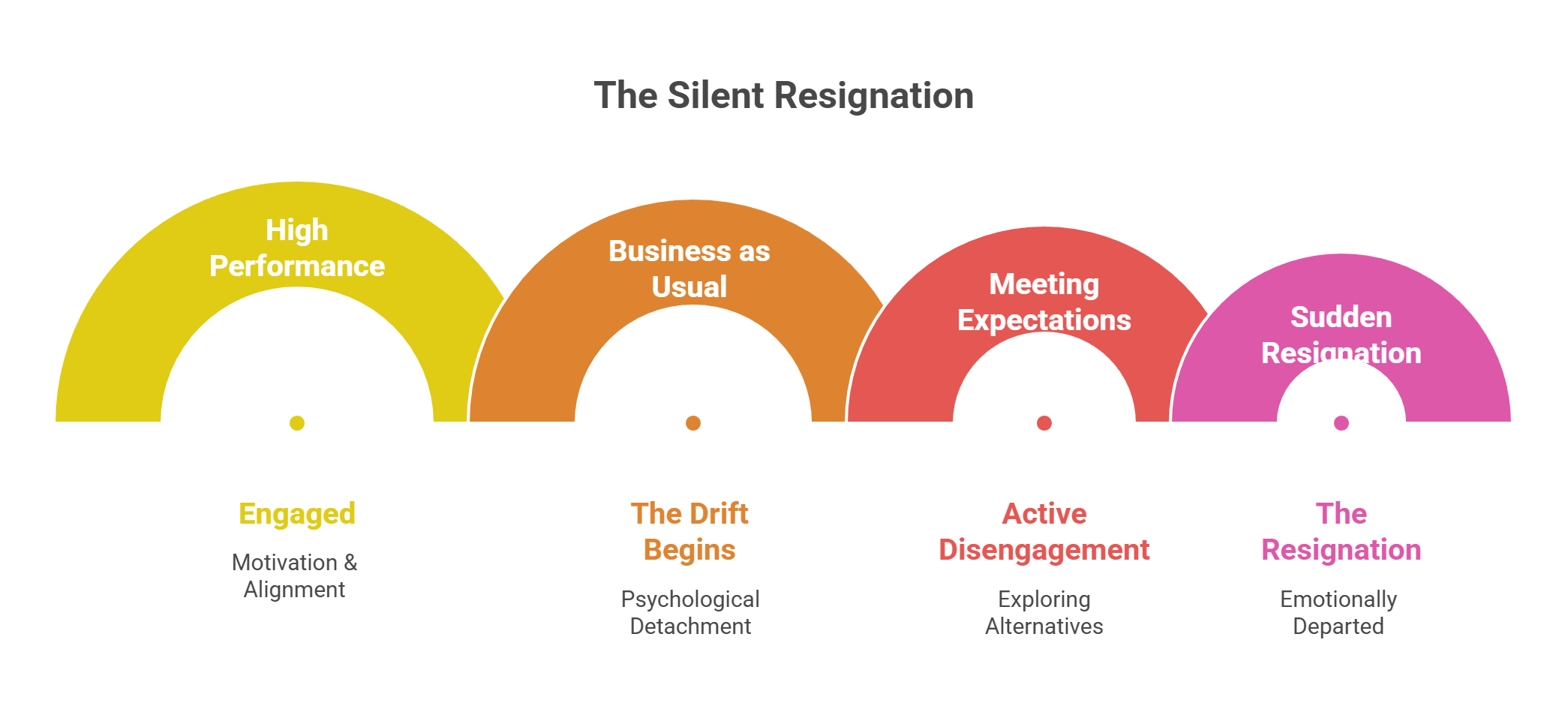
This scenario is painfully common. We spend so much time focusing on the loud, obvious signs of discontent that we miss the most dangerous threat to our teams: the silent resignation. This isn’t about “quiet quitting” or doing the bare minimum. This is the internal, emotional, and psychological departure that happens months before the physical one. It’s the slow, quiet drift of your most valuable people toward the exit, while on the surface, everything looks like business as usual.
Beyond the Balance Sheet: The True Cost of a Quiet Goodbye
When an employee leaves, the first thing leaders often calculate is the financial cost of replacement. We’re told it can cost anywhere from 1.5 to 2 times an employee’s annual salary to find and train their successor. That’s a significant hit, but it’s just the tip of the iceberg. The real damage from losing a key team member, especially one who leaves without warning, runs much deeper.
The Knowledge Drain
Think about all the unwritten rules, the historical context, the client quirks, and the clever workarounds that lived inside Sarah’s head. That’s institutional knowledge, and when it walks out the door, it leaves a gaping hole. The official documentation can never capture the nuance she provided. Projects stall, and simple tasks suddenly become complex investigations as the remaining team struggles to piece together the puzzle she effortlessly managed.
The Morale Meltdown
Your team is watching. When a respected, high-performing colleague leaves, it sends a powerful message. The immediate reaction is often a wave of uncertainty and anxiety. “If Sarah, who was so good at her job, left, what does that say about this place?” “Did she know something we don’t?” This doubt can be corrosive, leading others to polish up their own resumes. one departure can easily trigger a domino effect, turning a single problem into a full-blown retention crisis.
The Momentum Killer
Every team has a rhythm, a flow. A sudden departure shatters that momentum. The remaining team members are burdened with picking up the slack, often leading to burnout and resentment. The focus shifts from innovation and progress to simply keeping the lights on. That ambitious project you were about to launch? It just got pushed back a quarter. Your competitive edge dulls with every key person you lose.
Decoding the Silence: The Real Reasons for the Drift
So, why do good people leave? It’s rarely for the reason they give in the exit interview. The truth is far more nuanced. People don’t typically leave jobs; they leave futures they can no longer see themselves in. The silent resignation begins when the gap between their expectations and their reality grows too wide.
1. The Growth Ceiling
The single most common reason high-achievers disengage is stagnation. They master their role, solve the immediate problems, and then look up and see… nothing. Just a flat, endless horizon. They aren’t necessarily asking for a promotion or a new title, but they are desperate for a new challenge, a new skill to learn, a new problem to solve. When they stop learning, they start looking.
Think about it: Do you have a clear growth path for your top performers that goes beyond the traditional management track? Are you providing opportunities for them to lead projects, mentor others, or explore adjacent skill sets? If the only way up is a ladder with very few rungs, your best people will find a new building to climb.
2. The Value Void
Everyone wants to feel like their work matters. We crave a connection between our daily tasks and a larger purpose. When an employee spends their days ticking boxes and closing tickets without ever understanding the why behind their work, a sense of futility creeps in. They start to feel like a cog in a machine, easily replaceable and ultimately insignificant.
This is a leadership failure. It’s our job to be the storytellers, to constantly connect the team’s efforts to the company’s mission and the customer’s success. A developer isn’t just fixing a bug; they’re ensuring a small business owner can process payroll on time. A support agent isn’t just closing a ticket; they’re saving a client’s critical presentation. Without that narrative, the work loses its meaning, and so does the job.
3. The Recognition Deficit
Recognition is not about gift cards and pizza parties. Those are perks. True recognition is about being seen and valued for your unique contributions. It’s the difference between a generic “good job, team!” in a meeting and a specific, personal note: “David, the way you reframed the client’s problem in that meeting was brilliant. It completely changed the direction of the project for the better.”
A lack of meaningful recognition makes people feel invisible. When their extra effort, their clever insights, and their quiet consistency go unnoticed, they start to wonder why they bother. The motivation to go above and beyond withers, and they begin to emotionally divest from their role. They’re still doing the work, but their heart is no longer in it.
From Silent Resignation to Active Retention: A Leader’s Playbook
The good news is that you have the power to stop the silent resignation before it starts. Retention isn’t a program you roll out once a year; it’s an ongoing series of conversations and actions. It’s about creating an environment where people want to stay and grow.
Conduct ‚Stay‘ Interviews, Not Just Exit Interviews
Why wait until someone is leaving to ask them valuable questions? A ‘stay’ interview is a proactive, informal conversation designed to understand what keeps your employees here and what might cause them to leave. Schedule these regularly with your key people. Ask powerful questions like:
- “What do you look forward to when you come to work each day?”
- “What’s the most energizing part of your job? What’s the most draining?”
- “What would make your job more satisfying?”
- “What skills do you want to be building right now?”
- “What could happen that would make you consider leaving?”
Listen more than you talk. This simple act of showing you care about their experience can be one of the most powerful retention tools you have.
Map Careers, Not Just Job Descriptions
Shift your one-on-one conversations from being backward-looking status reports to forward-looking career discussions. Work with your team members to map out what their career journey could look like within the organization. This isn’t just about promotions; it’s about experiences.
Maybe your senior engineer doesn’t want to become a manager but would love to spend 20% of their time architecting a new system. Perhaps your marketing specialist wants to gain experience in product management. By creating flexible, personalized development plans, you show them that they have a future with you—a future they can help design. You transform their job from a static role into a dynamic journey.
Amplify Their Impact
Make it your mission to close the loop between effort and impact. When the team ships a new feature, share direct customer feedback about it. When a project helps the sales team close a major deal, bring the salesperson into a team meeting to share the story. Celebrate the small wins and connect them to the big picture.
This simple practice transforms work from a series of abstract tasks into a tangible contribution. It answers the fundamental human need to matter. When people see clear evidence that their work has a positive effect on the world, their engagement and loyalty skyrocket.
The Conversation is the Culture
Ultimately, preventing the silent resignation comes down to one thing: conversation. The most devastating departures are almost always preceded by a lack of meaningful dialogue. Your team members have hopes, frustrations, and ambitions. If they don’t have a safe, consistent outlet to discuss them with you, they will eventually find someone else to talk to—a recruiter.
Don’t wait for the exit interview. Don’t be the blindsided manager. The clues are there, but they are written in the language of silence, in the questions not being asked, and in the ambitions not being shared. It’s your job to break that silence.
So, here’s a challenge: Look at your calendar for this week. Who is the ‘Sarah’ on your team? Who is the quiet rockstar you can’t afford to lose? Schedule a conversation. Don’t talk about projects or deadlines. Ask them about their aspirations. Ask them what’s exciting them. Ask them what would make them want to stay for the long haul. That single conversation might be the most important thing you do all week.