The Ghost in the Machine
Remember the office? Not just the desk and the slightly-too-cold air conditioning, but the feeling of it. The low hum of activity, the spontaneous whiteboard sessions that solved a problem in ten minutes, the shared laughter over a bad cup of coffee. For decades, that physical space was the hardware on which company culture ran. We absorbed it by osmosis, through casual conversations, overhearing a senior leader’s phone call, or just feeling the collective energy of a team hitting a deadline.
Then, almost overnight, the hardware was unplugged. We were all sent home, and companies scrambled to replicate the office online. We filled our calendars with Zoom calls, flooded Slack channels with messages, and tried to pretend that a virtual happy hour was the same as sharing a drink after work. It wasn’t.
What we’ve been experiencing isn’t just a logistical shift; it’s a cultural one. The old way of building connection and alignment—through proximity—is gone. Relying on it now is like trying to run modern software on a computer from 1995. It just doesn’t work. The companies that are thriving in this new era of remote and hybrid work are the ones who understand a fundamental truth: When the office becomes an idea, not a place, your culture must become your operating system.
From Architecture to Code: Culture by Design, Not by Default
An operating system, at its core, is a set of rules and protocols that allows complex components to work together seamlessly. It manages resources, facilitates communication, and provides a stable environment for applications to run. This is the perfect metaphor for culture in a distributed world.
A culture-as-an-OS mindset means you stop leaving connection, communication, and collaboration to chance. You can no longer assume that people will ‚pick things up‘ by being around. Instead, you must intentionally design, document, and live by the principles that define your ‚invisible headquarters.‘ It’s a shift from culture as architecture (the physical layout of your office) to culture as code (the documented principles and protocols your team runs on).
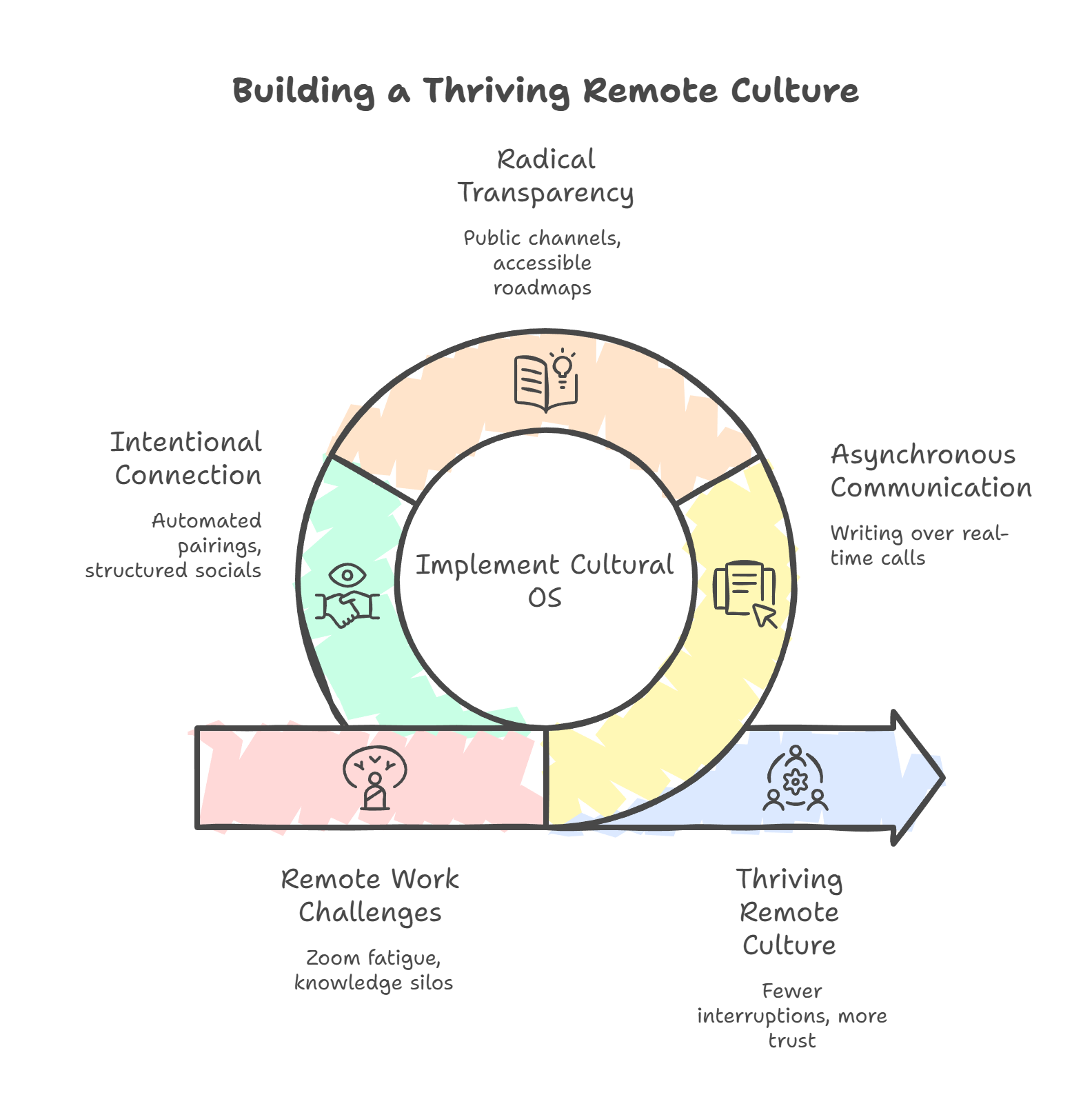
So, what does this actually look like? It’s built on three foundational pillars that transform how work gets done.
Pillar 1: Asynchronous by Default – The Communication Protocol
The biggest mistake many companies made in the shift to remote work was trying to replicate the synchronous, in-person office online. This led directly to Zoom fatigue, a feeling of being ‚always on,‘ and a workforce that was present but not productive. The solution isn’t more meetings; it’s better communication.
Adopting an ‚asynchronous-by-default‘ mindset is the single most powerful upgrade you can make to your cultural OS.
This doesn’t mean you never have meetings. It means that real-time conversation becomes a deliberate choice, not the default. It’s a shift from valuing quick responses to valuing thoughtful ones. In practice, this means:
- Writing is thinking. Instead of calling a meeting to ‚brainstorm,‘ a team member writes a detailed proposal or project brief in a tool like Notion, Confluence, or a simple Google Doc. They articulate the problem, the proposed solution, and the key questions. This forces clarity of thought from the start.
- Comments over calls. The team then engages with the document asynchronously. They leave comments, ask questions, and suggest edits *on their own time*. This allows for deeper reflection and accommodates different time zones and work schedules. A 60-minute ‚kick-off‘ meeting is replaced by a living document that becomes the source of truth.
- Show, don’t just tell. Instead of scheduling a screen-share, you record a quick Loom or Vidyard video to walk through a design, a piece of code, or a process. The recipient can watch it at 1.5x speed, pause it, and re-watch it as needed.
The result? Fewer interruptions, more time for deep work, and a more inclusive environment for introverts and those in different time zones. Your communication becomes more intentional and less reactive. It’s the core protocol of the invisible headquarters.
Pillar 2: Radical Transparency – The Single Source of Truth
In a physical office, information is everywhere. You overhear things, you see who is meeting with whom, you can walk over to someone’s desk. This informal information flow is a feature, but it’s also a bug—it’s inconsistent and creates knowledge silos. In a remote setting, it’s a catastrophic failure.
When you can’t see what’s happening, you need to be able to *read* what’s happening. This is where radical transparency becomes non-negotiable. Your cultural OS needs a robust, centralized ‚hard drive‘ where information is stored and accessible to everyone.
This is more than just having a shared Dropbox folder. It’s a commitment to:
- A Detailed Handbook: companies like GitLab are famous for their public handbooks, which document everything from their values to how to submit an expense report. This isn’t just for new hires; it’s a living document that codifies your cultural OS. How do we run meetings? What are our communication expectations? It should all be written down.
- Public by Default: Shift communication from private DMs and emails to public channels in Slack or Teams. A question asked in a public channel becomes a searchable answer for everyone. Project discussions that happen in the open provide context for the entire company, reducing the need for ’status update‘ meetings.
- Accessible Roadmaps and Goals: Everyone in the company should be able to easily see the company’s high-level goals (OKRs), the product roadmap, and key project timelines. When people understand the ‚why‘ behind their work and can see how it connects to the bigger picture, you foster a sense of ownership and purpose that proximity alone can never create.
Transparency builds trust, and in a remote environment, trust is the only currency that matters. When people have access to information, you empower them to make better decisions autonomously.
Pillar 3: Intentional Connection – Engineering Serendipity
Here’s the part that many remote-skeptics get right: you lose the spontaneous, human moments. The coffee machine chat, the walk to lunch, the shared glance across the room. These small interactions are the social glue that binds a team. In the invisible headquarters, you can’t leave this glue to chance—you have to engineer it.
This might sound sterile, but it’s the opposite. It’s about being deliberate in creating spaces for non-work human connection. It requires a dedicated budget, a strategy, and champions to make it happen.
Effective strategies include:
- Automated Pairings: Use tools like Donut for Slack to randomly pair colleagues from different departments for a 15-minute virtual coffee chat each week. It’s a low-lift way to break down silos and spark the kinds of cross-functional conversations that used to happen in the breakroom.
- Structured Socials: Go beyond the awkward virtual happy hour. Host activities with a clear focus, like a virtual escape room, a collaborative playlist-building session, or an online trivia game hosted by a professional. The structure gives people a reason to interact beyond staring at each other’s faces on a screen.
- Virtual ‚Watercoolers‘: Create dedicated channels for non-work interests, like #pets, #cooking, #gaming, or #what-youre-reading. These spaces give people permission to be their whole selves and connect on a personal level.
- Meaningful Offsites: When you do get together in person, don’t waste the time in a conference room with presentations. Prioritize connection. Focus on strategic workshops, team-building activities, and shared meals. Make the time together about strengthening the bonds that will sustain the team when they are apart.
These efforts show your team that you see them as people, not just as pixels on a screen. It’s a conscious investment in the social capital that makes a company feel like a community.
The Leader’s New Job: From Supervisor to Steward
In this new world, the role of a leader fundamentally changes. The old model of ‚management by walking around‘ is obsolete. You can’t gauge productivity by seeing who is at their desk, and you can’t solve problems by just pulling people into a room. Your new job is to be a steward and a role model for the cultural OS.
This means you must lead by example. You must become an excellent asynchronous communicator. You must champion transparency by sharing information openly. You must participate in the intentional connection rituals. Your primary role shifts from directing tasks to cultivating an environment where talented people can do their best work, wherever they are.
The invisible headquarters isn’t a lesser version of a real office. When designed with intention, it’s a more powerful, inclusive, and resilient way to work. It replaces the fragile bonds of physical proximity with the robust connections of shared principles, trust, and purpose. It’s not about recreating the old office online; it’s about building something better.
So, take a look at your own organization. Is your culture an accidental byproduct of old habits forced into a new context? Or is it the intentionally designed operating system for your company’s future?