
The SaaS Subscription That Looked Too Good to Be True
Let me tell you about a company we’ll call InnovateCorp. Their team was ecstatic. They’d just signed a three-year deal with a buzzy new SaaS provider for their core operations. On paper, it was a masterpiece of IT procurement. The price was 20% below the market leader, the feature list was a mile long, and the sales team promised a seamless, ‚white-glove‘ migration. Champagne corks were practically popping in the boardroom.
Fast forward six months. The ’seamless‘ migration was a buggy, data-loss-riddled nightmare. The ‚white-glove‘ support team was an understaffed call center on a different continent. Employee adoption was abysmal because the user interface was clunky and unintuitive. That 20% savings was being eaten alive by lost productivity, consultant fees to fix the integration, and the sheer morale drain on the team. The great deal had become a great burden.
Does this story sound familiar? Maybe a little too familiar? It’s a classic tale of focusing on the procurement but forgetting the partnership. In today’s tech-driven landscape, your IT vendors aren’t just suppliers; they are extensions of your team, the architects of your infrastructure, and the co-pilots of your growth strategy. Treating IT procurement as a simple cost-cutting exercise is like trying to win a Grand Prix by only focusing on getting a discount on the tires. You’ll lose the race, every single time.
It’s time to shift our perspective. Let’s move beyond the dotted line and explore how to transform transactional vendor relationships into strategic alliances that become a powerful, hidden engine for your growth.
Beyond TCO: Are You Measuring the Total Value of Partnership?
For years, the gold standard in procurement was Total Cost of Ownership (TCO). It was a huge leap forward from just looking at the sticker price. TCO forced us to consider implementation fees, training costs, maintenance, and other long-term expenses. It’s a valuable metric, but in the modern IT ecosystem, it’s no longer enough.
We need to start thinking in terms of Total Value of Partnership (TVP). TVP is a more holistic approach that includes TCO but adds crucial, value-driven dimensions:
- Innovation & Roadmap Alignment: Does your vendor’s product roadmap align with your company’s future goals? Are they innovating in ways that will help you stay ahead, or are they just maintaining the status quo? A true partner gives you a seat at the table, listening to your feedback to shape their future development.
- Support & Expertise: When things go wrong at 2 a.m., how good is their support? We’re not talking about just meeting an SLA. We’re talking about knowledgeable, empowered support staff who can solve complex problems quickly. Think of it as a ‚Return on Support’—how much downtime and frustration do they save you?
- Ecosystem & Integration: How well does this solution play with others in your tech stack? A tool that creates data silos or requires expensive custom integrations can have a negative value, no matter how cheap it is. A partner with a robust API and a strong ecosystem of integrations adds exponential value.
- Strategic Counsel: The best vendors don’t just sell you a product; they offer expertise. They’ve seen what works (and what doesn’t) across hundreds of companies. A strategic partner will proactively offer advice on best practices, helping you maximize the value of their tool and improve your own processes.
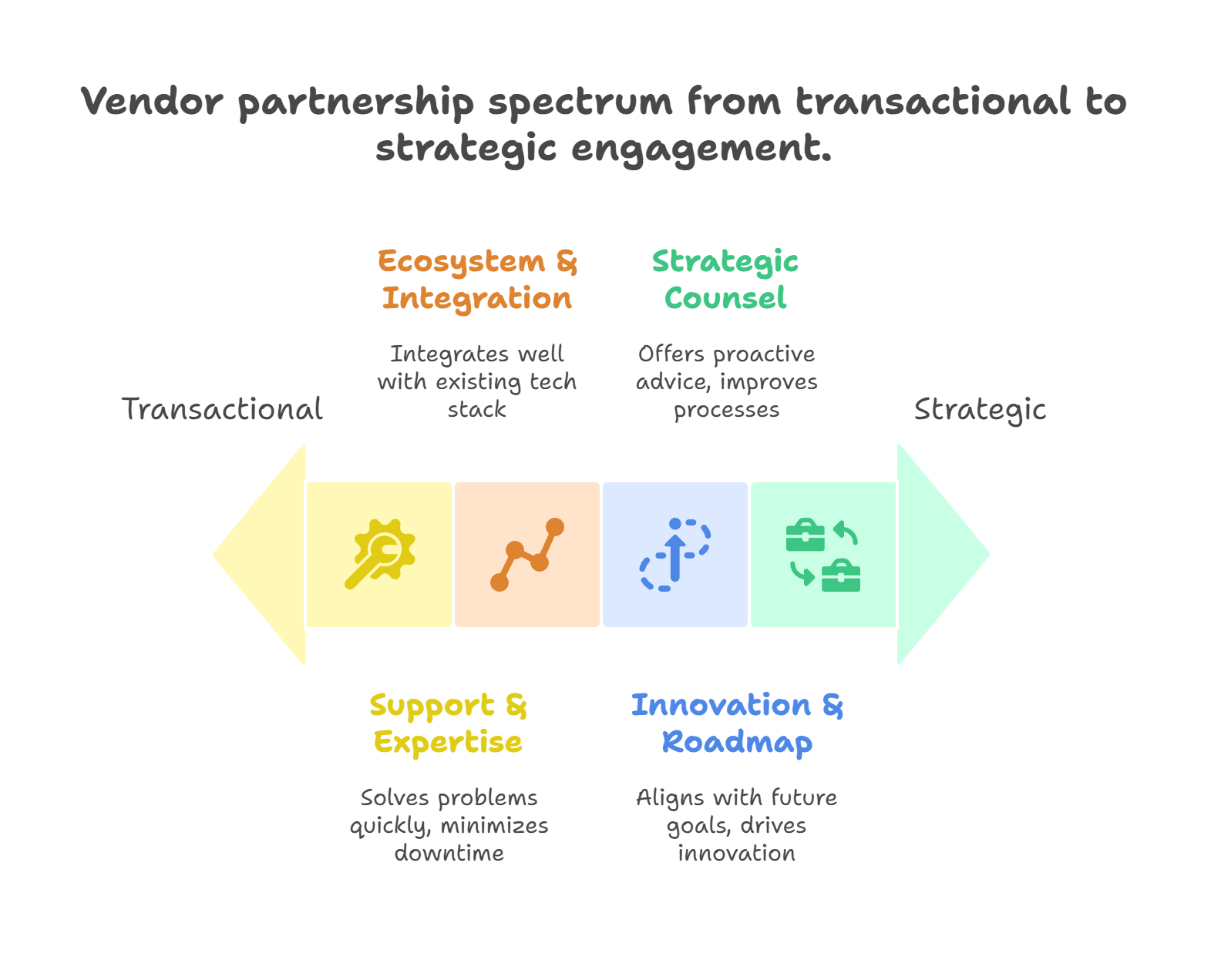
Thinking in terms of TVP fundamentally changes the questions you ask during the procurement process. You move from „What’s the cheapest option?“ to „Which partner will best accelerate our long-term success?“
The Proactive Procurement Playbook: From RFP to Partnership
If you want to find a strategic partner, you need a process designed to identify one. A rigid, price-obsessed Request for Proposal (RFP) process often filters out the most innovative and collaborative vendors, leaving you with the ones who are best at checking boxes. Here’s a more modern, proactive approach.
Step 1: The Internal Deep Dive (Before You Even Talk to a Vendor)
The most common procurement mistake is starting with a solution in mind. Don’t. Start with the problem. And get specific.
Gather a cross-functional team—not just IT and finance, but the actual end-users from sales, marketing, operations, etc. Instead of saying „We need a new project management tool,“ ask deeper questions:
- What specific bottlenecks are slowing down our projects?
- Where are communication breakdowns happening?
- What reporting gaps are preventing leadership from making good decisions?
- In a perfect world, what would this process look like for the people doing the work every day?
This internal alignment is your foundation. The detailed ‚problem statement‘ you create becomes the north star for your entire evaluation process.
Step 2: The Collaborative Vendor Scorecard
Now, take those insights and build a weighted scorecard. This ensures you evaluate every potential partner against the same, pre-agreed-upon criteria, removing personal bias and keeping the focus on what truly matters. Your categories should reflect the TVP mindset:
- Functional Fit (30%): How well does the solution solve our core, documented problems? (This is where your deep dive pays off).
- Partnership Potential (25%): We evaluate their support model, customer success stories, roadmap alignment, and the expertise of their team.
- Technical & Security (20%): Does it meet our standards for security, compliance, scalability, and integration?
- User Experience (15%): How intuitive and easy to use is it for our end-users? (Involve them in demos!).
- Total Cost of Ownership (10%): Notice the weighting. Cost is important, but it’s not the most important factor.
This scorecard forces a balanced conversation. The cheapest option may score poorly on user experience and partnership potential, making it a clear non-starter despite the attractive price.
Step 3: The Proof-of-Concept ‚Bake-Off‘
For critical software, a demo is not enough. You need to see it in action, with your data, solving your problems. Identify your top two or three vendors from the scorecard and propose a paid, time-boxed Proof of Concept (POC). Give them a real-world business challenge to solve.
This isn’t just about testing the software; it’s a critical test of the relationship. How do they handle questions? How creative are their solutions? How well do their people work with your people? The vendor who excels in the POC is often the one who will be the best long-term partner.
It’s a Relationship, Not a Transaction: Mastering Post-Contract Vendor Management
Remember InnovateCorp? Their biggest mistake was thinking the work was done when the contract was signed. In reality, that’s when the real work of vendor management begins. Signing the contract is like getting married; now you have to build the marriage.
The First 90 Days: The Onboarding Sprint
The success or failure of a new IT solution is often determined in the first 90 days. Don’t leave it to chance. Co-create a detailed onboarding plan with your new partner.
- Define Success Together: What does a successful implementation look like in 30, 60, and 90 days? Agree on specific, measurable KPIs (e.g., 80% user adoption, 50% reduction in manual reporting time).
- Establish Communication Rhythms: Set up a weekly check-in call. Create a shared Slack channel. Ensure everyone knows who to contact for what. Over-communication is your friend here.
- Champion the Change: Internally, you need to sell the ‚why‘ behind the new tool. Your vendor partner should provide resources—training materials, webinars, on-site support—to help you drive adoption.
The Quarterly Business Review (QBR): Your Strategic Huddle
A QBR should not be a glorified status update or a session for airing grievances. It should be a forward-looking, strategic meeting. A good QBR agenda looks like this:
- Review of Joint KPIs: How are we tracking against the success metrics we defined?
- Value Realization: Are we using the platform to its full potential? What features are we underutilizing?
- Vendor Roadmap Update: What’s new and upcoming? How can we leverage new features to meet our business goals?
- Your Roadmap Update: What are our company’s strategic priorities for the next 6-12 months? How can you, our partner, help us get there?
- Open Feedback & Brainstorming: A two-way street for honest feedback and collaborative problem-solving.
A vendor who just wants to talk about contract renewal is a supplier. A vendor who actively engages in these strategic conversations is a partner.
The Final Question: Suppliers or Partners?
Effective IT procurement and vendor management is one of the most underrated competitive advantages in business today. A recent study by McKinsey found that companies with strong supplier collaboration see higher growth, lower operating costs, and greater innovation than their peers. It’s not just a ’nice-to-have‘; it’s a direct line to a healthier bottom line and a more agile organization.
By shifting your mindset from cost to value, from RFPs to collaborative evaluations, and from transactional management to strategic relationship-building, you stop buying technology and start investing in partnerships that pay dividends for years to come.
So, take a look at your top five IT vendors. Ask yourself honestly: Are they just suppliers, or are they true partners in your success? And what’s one step you can take this week to start closing that gap?