
The Presentation That Almost Ended a Career
Picture this: a brightly lit conference room, the air thick with the scent of expensive coffee and expectation. Sarah, a brilliant and rising director, is at the helm. For six months, she’s poured her life into Project Titan, a strategic initiative poised to redefine the company’s market position. Her slides are immaculate, packed with data, progress charts, and meticulous financial projections. She knows the material inside and out.
But ten minutes into her presentation to the board of directors, she can feel the room growing cold. A board member, a titan of industry with a reputation for sharp questions, interrupts her mid-sentence. „I see the numbers, but I don’t see the story. Are we winning? Are we losing? And what’s the real risk here if that key dependency you breezed past on slide 14 slips?“
Sarah faltered. She had all the answers, but they were buried in spreadsheets and Gantt charts. She was reporting data; the board wanted insight and assurance. She was talking about project management; they were thinking about corporate governance and shareholder value. That day, she learned a hard lesson: in the world of high-stakes initiatives, managing stakeholders and communicating with the board isn’t a ’soft skill‘. It’s the skill.
If you’ve ever felt that disconnect—that moment where your detailed update fails to land with senior leadership—you’re not alone. We’re trained to manage tasks, timelines, and budgets. But true influence lies in managing perceptions, expectations, and relationships. This isn’t just about sending a weekly status email; it’s about conducting an orchestra of interests to create a symphony of strategic alignment.
Beyond the Org Chart: Mapping Your True Stakeholder Landscape
Most of us start stakeholder management with a list: the project sponsor, the department heads, the end-users. This is a good first step, but it’s like using a tourist map to navigate a dense jungle. It shows the main roads but misses the hidden paths, the influential elders, and the potential dangers lurking just out of sight. To truly succeed, you need to move from a static list to a dynamic stakeholder landscape.
You’ve probably seen the classic Power/Interest Grid. It’s a useful tool, but let’s reframe it with more nuance:
- High Power, High Interest (Manage Closely): These are your board members, your CEO, your primary sponsor. They are your co-pilots. They need more than just updates; they need to be active partners in your strategic narrative. Your communication with them should be proactive, concise, and focused on decision-making.
- High Power, Low Interest (Keep Satisfied): Think of a CFO who doesn’t care about your project’s technical details but deeply cares that it doesn’t cause budget overruns or compliance issues. Your job here is assurance. Provide them with high-level, predictable information that confirms everything is under control. Don’t burden them with details they don’t need.
- Low Power, High Interest (Keep Informed): This is your project team, your champions on the ground, the end-users who are excited about the change. They are your intelligence network. Keeping them informed and engaged builds morale and can provide you with crucial early warnings about potential roadblocks. They need to feel heard and valued.
- Low Power, Low Interest (Monitor): These stakeholders require minimal effort, but ignoring them completely is a mistake. A periodic, low-touch update (like a mention in a company-wide newsletter) is often enough to prevent them from becoming a source of friction later.
But the real art lies in identifying the informal influencers. Who does the CEO listen to over lunch? Which senior manager has the institutional memory of a similar project that failed five years ago? Who is the executive assistant that acts as a powerful gatekeeper to your main sponsor? Mapping these relationships—the whispers, the alliances, the quiet coffees—is what separates good project managers from true strategic leaders.
The Boardroom is Not a Status Meeting: Speaking the Language of Leadership
Communicating with a board of directors is a fundamentally different discipline than any other form of business communication. Their time is the company’s most expensive resource, and their focus is radically different. They aren’t there to help you solve project-level problems; they are there to provide oversight, mitigate enterprise-level risk, and ensure the organization is on a path to long-term success. To communicate effectively, you must shift your entire approach.
From Data Dump to Strategic Narrative
Your board doesn’t want to see your project plan. They want to understand how your project fits into the company’s story. Stop thinking in terms of “percent complete” and start thinking in terms of “progress against strategic goals.”
- Instead of:„We have completed 75% of the coding for Module B.“
- Try:„We are on track to deliver the new customer retention features in Q4. This milestone directly supports our corporate goal of reducing customer churn by 15% next year. We’ve navigated the key technical risks and are now focused on integration testing.“
See the difference? The first is a fact. The second is a narrative of value. It connects the work to the outcome, demonstrates foresight (mentioning risks), and frames the update in a language the board understands: strategic impact.
The „Pre-Meeting“ is the Real Meeting
Walking into a board meeting hoping to win over the room on the spot is a rookie mistake. The most successful leaders know that the meeting itself is often just the formal ratification of decisions and alignments that have already been built. This is the power of the pre-meeting.
Identify your key allies and potential skeptics on the board. Schedule brief, one-on-one calls with them in the days leading up to the meeting. This isn’t about lobbying; it’s about discovery and alignment. In these calls, you can:
- Test your narrative: Get a feel for how your key messages land.
- Uncover hidden concerns: A board member might have a question they’re hesitant to ask in a group setting. Answering it beforehand prevents you from being blindsided.
- Build a champion: By seeking their counsel, you make them a partner. When you’re in the room, your key ally can help reinforce your points or steer the conversation in a productive direction.
Mastering the Art of the Executive Summary
Assume your audience has only 60 seconds to understand your entire presentation. The executive summary, whether it’s the first slide of your deck or the first paragraph of your memo, is your entire pitch. It must be brutally efficient.
A powerful framework is the Situation-Implication-Recommendation (SIR) model:
- Situation: What is the current, objective state of affairs? „The market has shifted, and our primary competitor just launched a new product.“
- Implication: Why does this matter? What is the consequence or opportunity? „This puts our projected Q3 revenue at risk and threatens our market-leader position.“
- Recommendation: What do you need from them? What is the decision you are asking for? „We recommend accelerating the launch of Project Titan by four weeks, which requires an additional investment of $250k to be reallocated from the Q4 marketing budget.“
This structure immediately frames the conversation around a strategic decision, not a passive update. It respects their time and positions you as a proactive leader.
Navigating the Storm: Managing Conflict and Dissent
No significant project goes forward with unanimous, enthusiastic support. Dissent and conflict are not signs of failure; they are signs that the stakes are high and people are engaged. Your ability to navigate this turbulence is what will define your leadership.
A Real-World Scenario: The Skeptical CFO
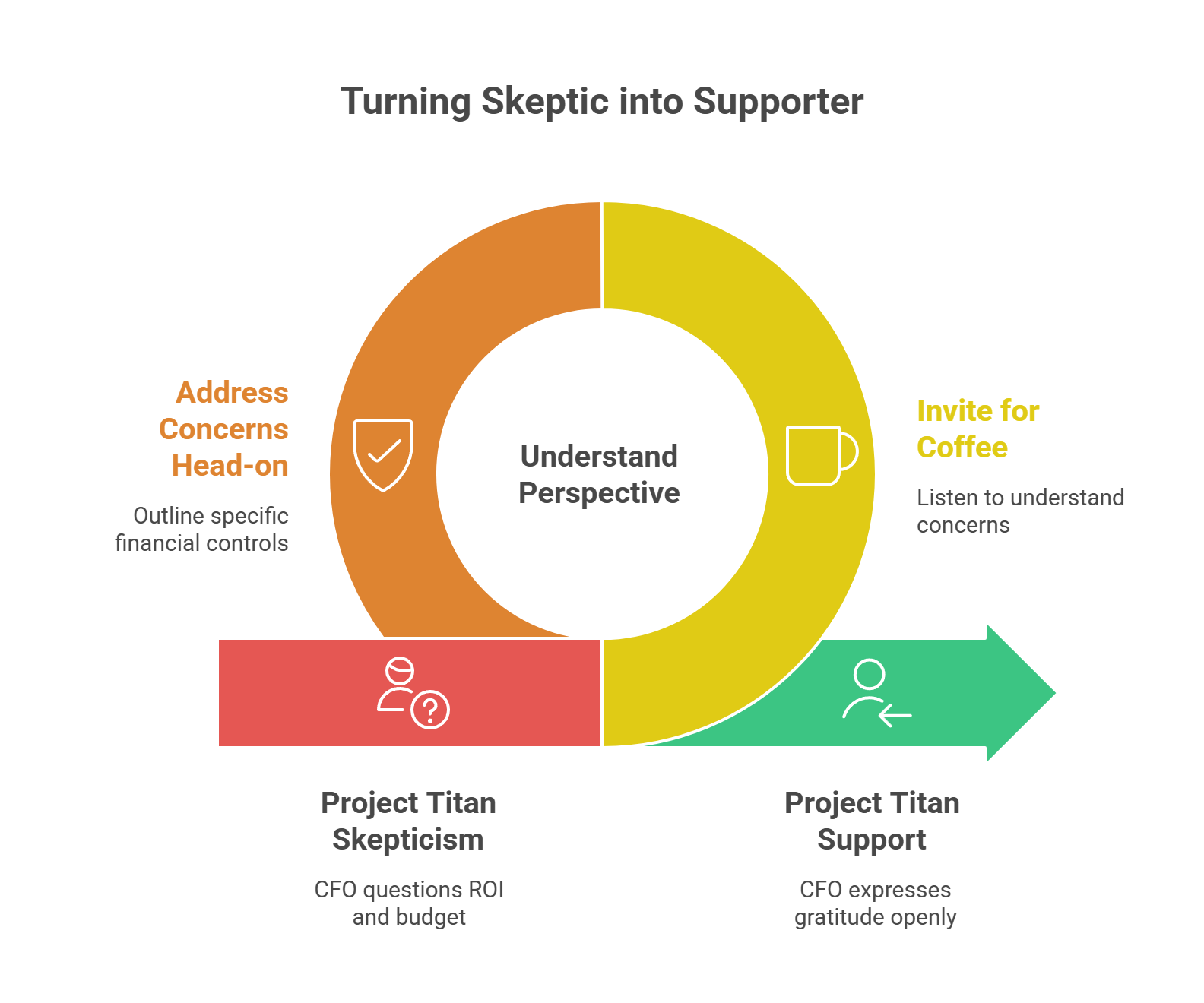
Let’s go back to Sarah. After her initial stumble, she regrouped. Her biggest skeptic was Mark, the CFO. In every meeting, Mark would relentlessly question the ROI and budget of Project Titan. Sarah’s initial reaction was to come to each meeting armed with more and more financial data, trying to win the argument with spreadsheets. It wasn’t working.
So, she changed her approach. She invited Mark for coffee with a simple agenda: „I want to understand your perspective better.“ She didn’t bring a laptop or a presentation. She just listened.
She learned that Mark’s resistance wasn’t about her project’s numbers. It stemmed from a massive IT project three years prior that had gone 200% over budget and nearly caused a public earnings miss. He wasn’t questioning her competence; he was haunted by a past failure. His underlying interest wasn’t to kill her project; it was to protect the company from financial risk and unpredictability.
This was a game-changer. In the next board meeting, Sarah addressed his concern head-on before he even had a chance to ask. She presented a slide titled, „Learning from the Past: De-Risking Project Titan’s Financials.“ She outlined the specific controls, the phased funding model, and the transparent reporting mechanisms she had put in place—many of which were directly inspired by the failures of the past project.
Mark didn’t just fall silent. He audibly said, „Thank you. That’s exactly what I needed to see.“ Sarah hadn’t just managed a stakeholder; she had turned a powerful detractor into a confident supporter by understanding and addressing his real concern, not just his stated objection.
Your Legacy is Built on Trust, Not Just Timelines
Ultimately, stakeholder management and board communication are about building one thing: trust. Trust that you have a command of the details. Trust that you see the big picture. Trust that you will bring them bad news with the same candor as good news. Trust that you are a responsible steward of the company’s resources and future.
This is a marathon, not a sprint. Every email, every presentation, every informal conversation is a deposit into (or a withdrawal from) your bank of political and social capital. When you shift your mindset from a reporter of facts to a strategic partner, you’re no longer just managing a project; you are leading a critical part of the business.
So, the next time you prepare that update for senior leadership, ask yourself a different set of questions. Don’t just ask, „What progress have we made?“ Ask, „What story does our progress tell? How does this story advance our shared strategic goals?“
The answer to those questions will change everything.