The New Great Game: More Than Just Code
The global race for artificial intelligence supremacy isn’t just about who can build the cleverest algorithm or the most powerful large language model. It’s a new ‚Great Game‘ being played on a digital frontier, and the stakes are nothing less than economic dominance, geopolitical influence, and the very definition of our future society. On one side, you have the United States, a powerhouse of private-sector innovation driven by Silicon Valley’s relentless, market-first philosophy. On the other, China, with its state-directed, data-rich approach, is achieving breathtaking scale and speed.
And then there’s Europe. For years, the continent has been perceived as a thoughtful, if somewhat slower, player in the tech world—a regulator, not an innovator; a referee, not a star player. But the European Commission has thrown down a gauntlet. With its ambitious action plan for AI and the landmark AI Act, the EU isn’t just aiming to participate. It’s aiming to lead, championing a ‚third way’—a human-centric, trustworthy model for AI.
The central question, however, hangs heavy in the air of Brussels and beyond: Is this a masterstroke of strategic foresight, creating a gold standard for responsible AI that the world will adopt? Or is it a beautifully crafted set of rules for a game Europe is no longer competitive enough to play? Let’s deconstruct this high-stakes gambit.
Understanding the ‚Brussels Effect‘ in the Age of AI
To grasp the EU’s strategy, you first have to understand the ‚Brussels Effect’—the phenomenon where EU laws and standards are adopted globally because of the sheer size and importance of its single market. We saw it with GDPR; companies worldwide adapted their data privacy practices to comply. The EU is betting it can do the same for AI, making ‚Made in Europe‘ a kitemark for ethical, reliable, and trustworthy artificial intelligence.
The action plan rests on a foundation designed to make this vision a reality, focusing on excellence and trust.
Pillar 1: The Push for Excellence (Money and Machines)
The plan calls for a significant boost in investment, aiming to mobilize over €20 billion per year in public and private funding. Initiatives like the Digital Europe Programme and Horizon Europe are designed to funnel capital into AI research and deployment. A key part of this is the creation of ‚AI-on-demand‘ platforms and networks of Testing and Experimentation Facilities (TEFs), where businesses, especially SMEs, can access cutting-edge technology and expertise.
The critical lens: While €20 billion sounds impressive, it pales in comparison to the capital flowing from private venture funds in the US. In 2023 alone, US-based AI companies raised over $50 billion in private funding. The EU’s approach is more structured and public-driven, but can it match the sheer velocity and risk appetite of the American venture capital ecosystem? The plan is to build the infrastructure, but the race is often won by those who can fuel the engine with the most high-octane capital.
Pillar 2: The People-Powered Engine (Talent and Skills)
An AI ecosystem is nothing without brilliant minds. The Commission’s plan emphasizes attracting and retaining top AI talent through specialized Master’s programs, doctoral networks, and initiatives to reskill the workforce. The goal is to create a virtuous cycle: leading research institutions attract top talent, who then build innovative companies, who in turn attract more talent. It’s a recognition that the war for AI dominance is, fundamentally, a war for talent.
The critical lens: This is perhaps the plan’s most challenging pillar. The global market for AI experts is hyper-competitive. Tech giants in the US offer salaries and equity packages that are often difficult for European startups or even established companies to match. While Europe boasts world-class universities, it has historically struggled with ‚brain drain.‘ Reversing this trend requires more than just funding for PhDs; it demands the creation of a vibrant commercial ecosystem where that talent can thrive and see a clear path to building a globally significant company.
Pillar 3: The Rulebook for Trust (The AI Act)
This is the centerpiece of the EU’s strategy. The AI Act is the world’s first comprehensive legal framework for AI. It employs a risk-based approach, which is elegant in its logic:
- Unacceptable Risk: Systems that are a clear threat to people’s safety and rights are banned outright (e.g., social scoring by governments, real-time biometric surveillance in public spaces with few exceptions).
- High-Risk: AI systems that could negatively impact safety or fundamental rights are subject to strict obligations before they can be put on the market. This includes AI used in critical infrastructure, medical devices, hiring, and law enforcement. They need robust risk assessments, high-quality data sets, and human oversight.
- Limited Risk: Systems like chatbots must ensure users know they are interacting with a machine.
- Minimal Risk: The vast majority of AI systems (e.g., spam filters, AI in video games) fall into this category with no new legal obligations.
This regulation is the EU’s primary gambit—betting that in a world wary of AI’s potential harms, a framework that guarantees safety and ethics will become a powerful competitive advantage.
The Sovereignty Paradox: Building a Fortress or a Global Hub?
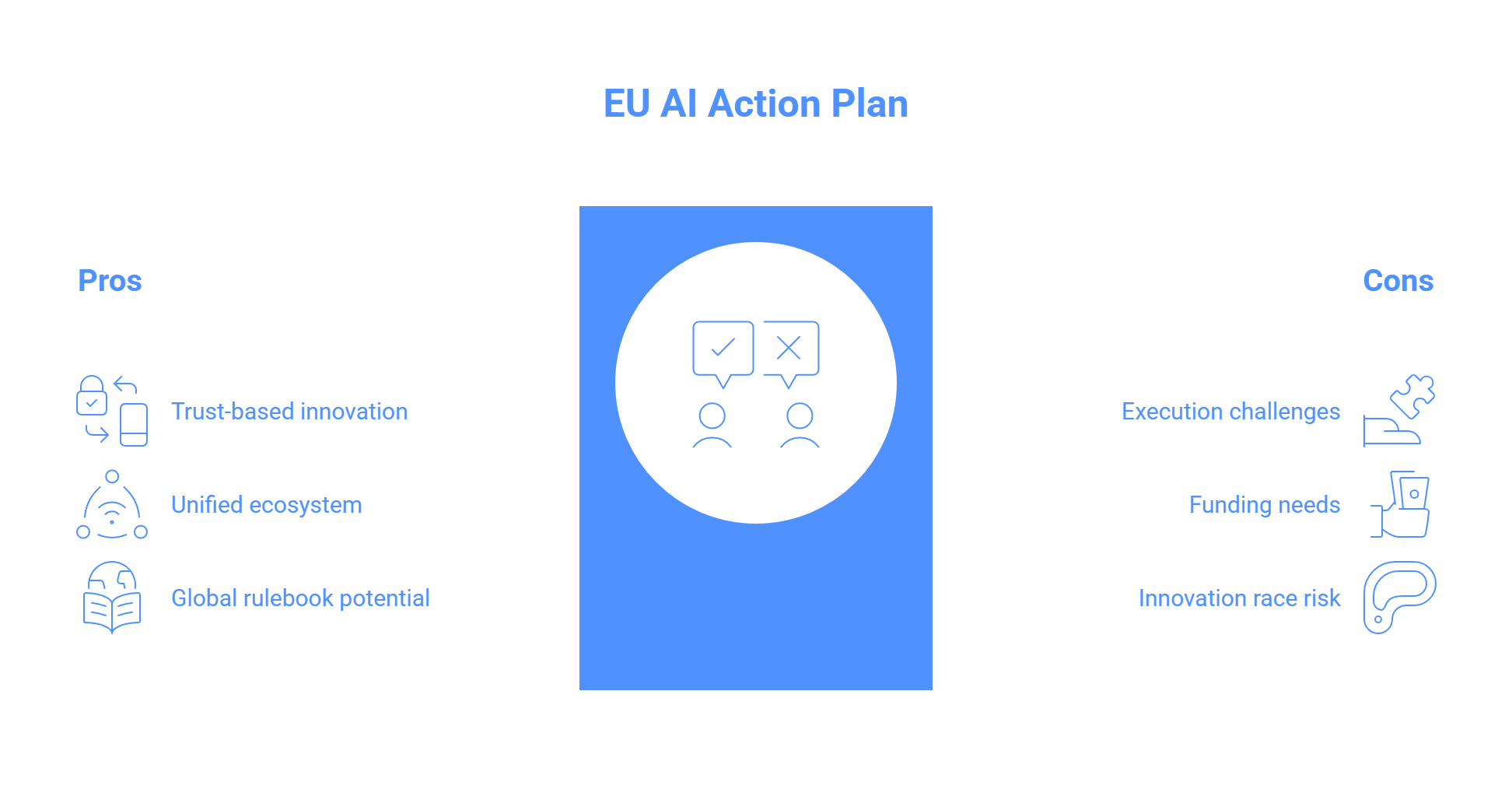
On paper, the plan is coherent and principled. But its execution faces a profound paradox. In its quest for ‚digital sovereignty‘ and control, could the EU inadvertently be isolating itself from the fast-paced, often messy, global innovation cycle?
The Innovation-Regulation Tightrope
The most common criticism leveled against the AI Act is that it could create a ‚chilling effect‘ on innovation. Imagine you’re a European startup developing a new AI-powered diagnostic tool for hospitals. Under the Act, this is a high-risk system. Before you can even get your product to a pilot stage, you face a mountain of compliance requirements for data governance, technical documentation, risk management, and conformity assessments.
Meanwhile, your competitor in a different jurisdiction might be able to iterate faster, deploy their model with real-world data sooner, and capture market share while you’re still navigating the regulatory labyrinth. The counterargument, of course, is that the EU startup, having met these high standards, will have a more robust, trustworthy, and ultimately superior product. But in the world of tech, speed is often a feature in itself. The AI Act aims to prevent a race to the bottom on safety and ethics, but it risks taking European innovators out of the race altogether.
The Persistent Funding and Fragmentation Gap
Beyond regulation, the ecosystem faces structural challenges. The EU’s venture capital market remains fragmented and significantly smaller than that of the US. An entrepreneur in Sofia or Lisbon has a much harder time accessing large, late-stage funding rounds than their counterpart in Austin or Palo Alto. This ’scale-up gap‘ is a critical weakness. Europe is good at creating startups; it’s less successful at turning them into global giants like Google or Meta.
Furthermore, while it’s called the ‚European Union,‘ executing a unified strategy across 27 member states with different languages, legal systems, and economic priorities is a colossal challenge. A policy that works for Germany’s industrial base might not be the right fit for Estonia’s digital-native economy. This internal fragmentation stands in stark contrast to the more monolithic ecosystems of the US and China.
Charting the Course: Four Steps to Turn Ambition into Reality
The EU’s action plan is not doomed to fail. Its vision is commendable. But to succeed, it must move from a philosophy of control to a strategy of enablement. The rules are being written; now the focus must shift to building the stadium where European players can win.
1. Supercharge Regulatory Sandboxes
The AI Act includes provisions for ‚regulatory sandboxes’—controlled environments where companies can test innovative AI systems under the supervision of regulators. This is a brilliant idea that needs to be supercharged. Instead of small, isolated pilots, the EU should launch large-scale, pan-European sandboxes for key sectors like healthcare, energy, and finance. This would create a safe harbor for innovation, allowing companies to collaborate directly with regulators to find a path to compliance, turning the rulebook from a barrier into a guide.
2. Cultivate ‚Sovereign Champions‘
The EU needs its own large-scale AI players who can compete on the global stage. While supporting SMEs is vital, there must also be a clear strategy to help promising companies scale up. This means facilitating cross-border mergers, creating a true single market for capital, and using public procurement to champion European technologies. Companies like Germany’s Aleph Alpha or France’s Mistral AI show promise, but they need a continental ecosystem that actively supports their journey to becoming global heavyweights.
3. Forge Strategic ‚Value-Based‘ Alliances
Europe cannot—and should not—go it alone. The ‚Brussels Effect‘ is most powerful when it’s not perceived as protectionism. The EU should proactively build a coalition of democratic nations—including Canada, Japan, the UK, and even collaborating with the US on shared principles—to establish global norms for trustworthy AI. By creating a larger, unified market for regulation-compliant AI, it can shift the global center of gravity away from models that lack transparency and ethical oversight.
4. Shift the Narrative from Risk to Opportunity
Right now, the public discourse around the EU’s AI plan is dominated by risk, compliance, and limitations. This is a branding problem. The EU needs a powerful, parallel narrative that focuses on opportunity. How can AI help Europe solve its biggest challenges—from an aging population and climate change to industrial competitiveness? By framing AI not as a threat to be contained but as a powerful tool for achieving European societal goals, the Commission can inspire a generation of innovators to build solutions that are not only compliant but also world-changing.
The Final Move
The European Union stands at a critical juncture. Its AI action plan is a bold, necessary, and deeply European response to the defining technology of our time. It’s a bet that in the long run, trust is a more durable currency than speed-at-all-costs innovation.
But the success of this grand gambit will not be determined by the elegance of its regulations. It will be won or lost in the execution. It depends on the EU’s ability to create a dynamic, well-funded, and unified ecosystem that empowers its innovators to not just follow the rules, but to use them as a foundation to build the future.
Is Europe writing the global rulebook for the 21st century, or is it drafting its own beautifully written obituary in the innovation race? The next few years will decide which it is.