
The Tip of the Iceberg: What Everyone Sees
Scroll through your news feed, and you’ll see it. The headlines are stark, and the narrative is simple: AI is coming for our jobs. Big tech companies announce layoffs, citing a pivot to artificial intelligence. Experts predict entire professions will be automated into oblivion. It’s a compelling, and frankly, terrifying story. We see the visible part of the change—the layoffs, the shuttered departments—and we mistake it for the whole picture.
This is the tip of the iceberg. It’s real, it’s disruptive, and for those affected, it’s a profound challenge. But according to groundbreaking new research, it represents a mere fraction of a much larger, deeper, and more complex transformation happening just below the surface.
A late November study from MIT, developed with the Oak Ridge National Laboratory, has given us a new lens to view this monumental shift. It introduces a concept called the „Iceberg Index,“ and it suggests that the real story isn’t about mass unemployment. It’s about a quiet, massive restructuring of the very tasks that make up our jobs. And it’s already here.
Diving Below the Surface: The Hidden 90%
The MIT study is staggering in its scale. It simulated the entire US labor market—151 million workers—and compared their skills against the capabilities of over 13,000 AI tools. The findings flip the conventional wisdom on its head.
While the visible impact, like the tech layoffs that dominate headlines, accounts for about 2.2% of the wage bill ($211 billion), the study found that current AI systems are already technically capable of performing tasks that make up 11.7% of the US labor market. That’s a value of roughly $1.2 trillion in wages. The vast majority of this impact is not in eliminating jobs, but in automating routine tasks within existing jobs.
This is the submerged, invisible part of the iceberg. It’s not the dramatic explosion of a ship hitting the ice; it’s the silent, powerful current changing the direction of the entire ocean. It’s happening in departments and roles we don’t typically associate with the AI revolution.
Where the Real Change is Happening
Forget the image of a robot on an assembly line. The study highlights that the most significant transformations are occurring in professional services, finance, healthcare, and administration. Think about the daily grind of many roles:
- The HR Manager: They used to spend a third of their week manually screening hundreds of resumes for a single opening. Now, an AI system does the initial sift in minutes, flagging the top 10 candidates based on nuanced criteria. That HR manager isn’t out of a job. Instead, they’re freed up to focus on strategic workforce planning, developing company culture, and conducting deeper, more meaningful interviews. Their job hasn’t been replaced; it has been elevated.
- The Financial Analyst: Their world was once dominated by Excel spreadsheets and manual data entry to detect anomalies. Today, AI algorithms monitor thousands of transactions per second, flagging potential fraud with incredible accuracy. The analyst’s role shifts from data-cruncher to strategic investigator, interpreting the AI’s findings, understanding the context, and advising clients on complex risks.
- The Logistics Coordinator: Previously, their day involved endless phone calls and frantic calculations to manage a fleet of delivery trucks. Now, an AI-powered platform optimizes routes in real-time, accounts for traffic and weather, and predicts delivery windows. The coordinator now manages exceptions, builds relationships with key partners, and strategizes on how to make the entire supply chain more resilient.
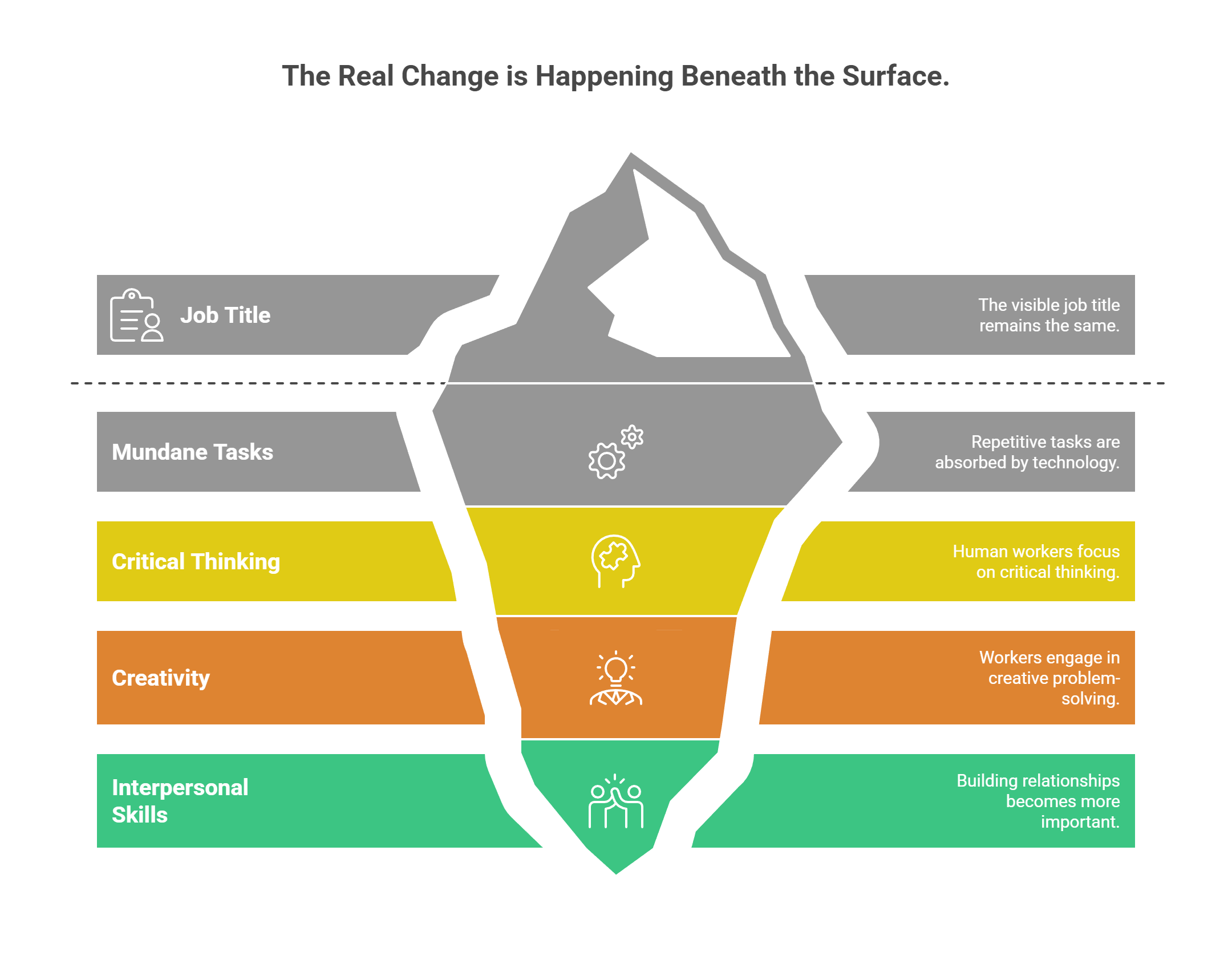
In each case, the job title remains the same, but the day-to-day reality is fundamentally different. The mundane, repetitive tasks are being absorbed by technology, pushing human workers toward tasks that require critical thinking, creativity, and interpersonal skills. This isn’t a future prediction; it’s the quiet reality in thousands of companies right now, from bustling city centers to rural counties the study shows are being impacted just as much.
The Measurement Gap: Why Our Old Maps Are Useless
So if this massive shift is happening, why don’t we see it in the headline economic numbers? This is what the MIT researchers call the „measurement gap.“
We’re trying to navigate this new world with old maps. Traditional indicators like GDP and the national unemployment rate were designed for an industrial economy, where job loss was a clear-cut event. A factory closed, and a thousand people were unemployed. The numbers told the story.
Today, the story is far more subtle. The national unemployment rate can remain low, painting a picture of a healthy job market. But beneath that single number, a seismic churn is taking place. People aren’t necessarily losing their jobs, but the skills required to perform their jobs are changing at an unprecedented speed. This creates a dangerous paradox: a skills shortage coexisting with technological displacement.
Companies are desperate for people who can manage AI systems, interpret complex data, and think strategically, while the workforce may still be trained for the routine tasks that are quickly becoming obsolete. Relying on unemployment figures to understand AI’s impact is like checking a thermometer to measure wind speed. You’re measuring the wrong thing entirely.
This is why new metrics like the Iceberg Index are so critical. They give policymakers and business leaders a high-resolution map of where skills are becoming redundant and where new opportunities are emerging, allowing for a much more targeted and effective response.
Navigating the New Waters: From Fear to Proactive Strategy
The realization that this change is both inevitable and already underway can be daunting. But it also offers a clear path forward. Instead of passively waiting for the „job apocalypse,“ we can actively shape our response. The horse-and-carriage analogy is tired, but the underlying truth remains: major technological shifts reward those who adapt.
What Can You Do as an Individual?
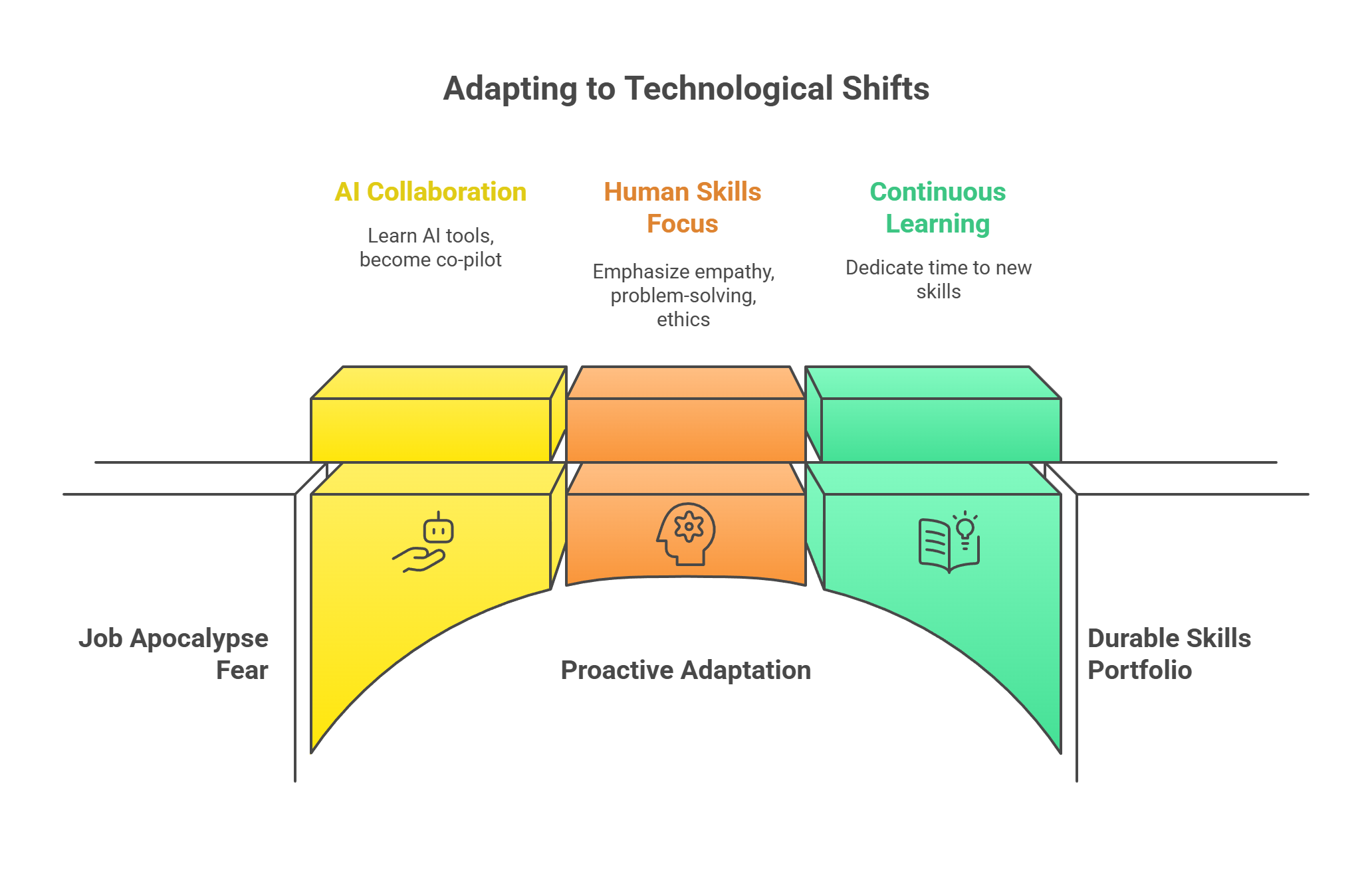
The focus must shift from protecting a specific job to building a portfolio of durable skills. It’s no longer about what you know, but how well you can learn, adapt, and collaborate with intelligent systems.
- Become an AI Collaborator: Don’t view AI as a competitor; see it as a co-pilot. Learn to use the AI tools relevant to your field. The professional who can effectively prompt a generative AI, interpret its output, and use it to enhance their work will be infinitely more valuable than one who resists it.
- Double Down on Human Skills: AI is excellent at processing data and executing routine tasks. It’s not good at empathy, creative problem-solving, ethical judgment, or building trust. These „soft skills“ are becoming the hard currency of the new economy.
- Embrace Continuous Learning: Your degree or certification is a starting point, not a destination. Dedicate time each week to learning a new skill, understanding a new technology, or reading about trends in your industry. Lifelong learning is no longer a buzzword; it’s a survival strategy.
A New Playbook for Companies and Governments
For organizations, the knee-jerk reaction is to use AI for cost-cutting by eliminating headcount. The MIT study suggests this is shortsighted. The real opportunity lies in role redesign and augmentation.
Companies that thrive will be those that invest in upskilling their existing workforce, redesigning jobs to pair human strengths with AI efficiency. This creates a more productive, innovative, and engaged team capable of tackling higher-value challenges.
For governments, the path is equally clear. As the state of Tennessee is already doing with MIT’s model, policymakers can move from reactive unemployment benefits to proactive, data-driven reskilling programs. By using tools like the Iceberg Index, they can identify which skills will be in demand in their specific regions and create targeted educational initiatives to prepare their citizens for the jobs of tomorrow, not yesterday.
Conclusion: Look Deeper
The narrative of AI and job loss is simple, scary, and sells clicks. But it’s a distraction from the real, far more significant story. The true AI revolution isn’t a tidal wave of unemployment that will crash upon us one day. It’s a steady, powerful, and silent rising of the sea level that is already redefining the landscape of work from within.
The conversation needs to evolve. We must move past the fear of the visible tip of the iceberg and focus our energy on understanding and navigating the immense, hidden mass below. The question is no longer *if* AI will change your job, but *how* it is already changing it. Are you prepared to look below the surface?