The Ghost in the Machine
Remember that one project? The one everyone was afraid to touch? It probably had a name, whispered in hushed tones during stand-ups—something like „Project Chimera“ or „the legacy monolith.“ It worked, mostly, but every new feature request was met with a collective groan. The code was a labyrinth of quick fixes, forgotten logic, and comments like // I don't know why this works, but don't remove it. That feeling, that heavy, invisible drag on productivity, is the ghost of technical debt.
For decades, we’ve fought this ghost with code reviews, style guides, and sheer developer discipline. It was a constant, manual battle against entropy. Then, seemingly overnight, a new ally appeared: the AI coding assistant. Tools like GitHub Copilot, Amazon CodeWhisperer, and Tabnine promised to write our boilerplate, suggest elegant solutions, and even explain cryptic code. The dream was tantalizing: what if we could build faster *and* cleaner, leaving technical debt as a relic of a bygone era?
But as the initial euphoria settles, a more complex reality is emerging. Is AI the ultimate debt collector, helping us refactor our way to a clean slate? Or is it a subprime lender, offering us cheap, fast code now at the cost of a much bigger, more insidious debt down the line? The answer, as with most things in engineering, is: it’s complicated.
First, A Quick Refresher: What We’re Really Talking About
Before we dive into the AI paradox, let’s align on what technical debt truly is. The term was coined by Ward Cunningham, a signatory of the Agile Manifesto. His original metaphor is brilliant. He compared the compromises we make in software development to financial debt. Sometimes, you take on debt intentionally—a strategic shortcut to get a product to market faster. You know you’ll have to „pay it back“ later with interest, which comes in the form of refactoring and cleanup.
This is prudent technical debt. It’s a calculated business decision. But there’s also the other kind: the messy, unintentional, „we’ll fix it later“ kind that festers from carelessness or a lack of understanding. This is reckless technical debt, and it’s what turns promising codebases into digital haunted houses.
Technical debt isn’t just „bad code.“ It manifests as:
- Code Debt: Poorly written, complex, or duplicative code.
- Architectural Debt: Flawed system design that makes change difficult.
- Test Debt: Inadequate or brittle test coverage.
- Documentation Debt: Missing, outdated, or unclear documentation.
This is the landscape AI has entered. So, how is it changing the game?
The Optimist’s View: AI as the Ultimate Debt Consolidation Tool
There’s a strong case to be made that AI assistants are one of the most powerful tools we’ve ever had for *reducing* existing technical debt. When wielded with intention, they can be transformative.
1. The Refactoring Accelerator
Imagine a 300-line function that has grown organically over five years. It does three different things, has no tests, and everyone is terrified to modify it. This is classic, high-interest tech debt. A senior developer could spend a day carefully untangling it. An AI assistant, with the right prompts, can do the initial heavy lifting in minutes.
You can prompt it with: „Refactor this function into three smaller, single-responsibility functions. Add comprehensive docstrings and suggest unit tests for each.“ The AI won’t produce a perfect, production-ready result, but it provides a massive head start. It transforms a daunting, monolithic task into a more manageable review-and-refine process. It lowers the activation energy required to start paying down debt.
2. The End of Documentation Debt?
Let’s be honest: most developers don’t love writing documentation. It’s often the first thing to be skipped when deadlines are tight. This leads to code that’s impossible for newcomers (or your future self) to understand. AI assistants are exceptionally good at this. They can analyze a function and generate clear, consistent comments and docstrings in seconds. This isn’t just a convenience; it’s a direct payment on one of the most common forms of technical debt, making codebases more maintainable and accessible overnight.
3. Demystifying the Legacy Labyrinth
One of the biggest costs of tech debt is onboarding time and the fear of the unknown. When a new developer joins a team, they can spend weeks trying to understand a complex, poorly documented system. AI changes this dynamic. Instead of bugging a senior engineer, the new developer can highlight a confusing block of code and ask the AI, „Explain what this legacy code does, what are its inputs and outputs, and what are the potential side effects?“ This democratizes knowledge and empowers developers to contribute meaningfully, much faster, without being paralyzed by the fear of breaking something they don’t understand.
The Pessimist’s Warning: The Rise of AI-Generated Technical Debt
For every action, there is an equal and opposite reaction. While AI offers powerful ways to pay down debt, its misuse can create a new, more subtle, and potentially more dangerous form of it. Welcome to the world of AI-generated technical debt (AIG-TD).
1. Plausible but Wrong: The Silent Killer
The most dangerous code isn’t the code that immediately crashes; it’s the code that seems to work but has a subtle, hidden flaw. AI assistants are masters of generating „plausibly correct“ code. It looks right, it uses the right libraries, and it passes basic tests. But it might contain a subtle race condition, a security vulnerability, or an inefficient algorithm that only reveals itself under production load.
A junior developer, trusting the tool, might merge this code without a deep understanding of its implications. The bug it introduces might not surface for months. When it does, it’s a high-interest debt that’s incredibly difficult to trace back to its origin because the code *looked* fine. The cognitive load of reviewing AI-generated code is arguably higher than reviewing human-written code because you have to fight the bias of its confident, clean-looking output.
2. Architectural Anarchy and „Vibe Coding“
This is perhaps the biggest risk. Good software isn’t just a collection of functions that work; it’s a well-designed system with clear boundaries, consistent patterns, and a coherent architecture. AI assistants operate at a local, function-level scope. They don’t understand your grand architectural vision.
A developer working on a feature might get stuck and ask the AI for a solution. The AI provides a snippet. They get stuck again, and ask for another snippet. This is what’s been called „AI-assisted vibe coding.“ You’re stringing together locally-optimized solutions without a global plan. The result? A codebase that’s a patchwork of inconsistent styles and patterns. It’s a form of architectural debt where the system becomes a „big ball of mud“ much faster than ever before. Every component might be well-written in isolation, but the system as a whole is brittle and incomprehensible.
3. The Black Box Effect
Sometimes, the AI will generate a complex piece of code—perhaps some clever bit manipulation or a dense regular expression—that just works. The developer, happy to move on, accepts it without fully understanding it. This code is now a „black box“ within the system. No one on the team knows how it works, why it works, or how to fix it when it inevitably breaks on some edge case. You’ve traded a few minutes of development time for a future of confusion and maintenance risk. This is the very definition of taking on reckless debt.
The Balanced View: From Code Writer to Code Curator
So, is AI a friend or a foe? The truth is, it’s neither. AI is an accelerant. It will accelerate good practices, and it will accelerate bad practices. It doesn’t eliminate technical debt; it changes its nature and shifts the responsibility of managing it.
The era of the AI coding assistant demands a new kind of developer—one who is less of a pure code generator and more of a systems thinker and critical reviewer. The most valuable skills are no longer just about writing code, but about:
- Prompt Engineering: Knowing how to ask the AI the right questions to get high-quality, architecturally sound suggestions.
- Aggressive Code Review: Treating AI-generated code with healthy skepticism. The question is no longer „Does it work?“ but „Is it right? Is it maintainable? Does it fit our architecture? Do I understand it?“
- Architectural Stewardship: Maintaining a strong vision for the system’s architecture and ensuring that AI-generated contributions adhere to it, not detract from it.
Think of your AI assistant as the most talented, productive, and occasionally reckless junior developer you’ve ever worked with. It’s incredibly fast and knows a lot, but it has zero context about your project’s long-term goals and needs constant supervision from a senior engineer. Your job is to provide that supervision.
Putting It Into Practice: A New Playbook
How do you harness the power without falling into the traps? It requires a conscious shift in team culture and process.
- Establish AI Usage Guidelines: Don’t let it be a free-for-all. Create clear guidelines on when and how to use AI assistants. For example: „Excellent for boilerplate, unit tests, and refactoring known patterns. Use with extreme caution for core business logic and new algorithms.“
- Mandate „Explain It to Me“ Reviews: During code reviews, if a developer submits a complex piece of AI-generated code, they must be able to explain it, line by line, in their own words. If they can’t, it doesn’t get merged. This combats the „black box“ problem.
- Focus on AI-Assisted Debt Paydown Sprints: Be intentional. Dedicate specific time (e.g., one Friday a month) to tackling the tech debt backlog using AI tools. Use them as a weapon for good, targeting the gnarliest parts of your codebase for refactoring and documentation.
The Debt Remains, The Collector Has Changed
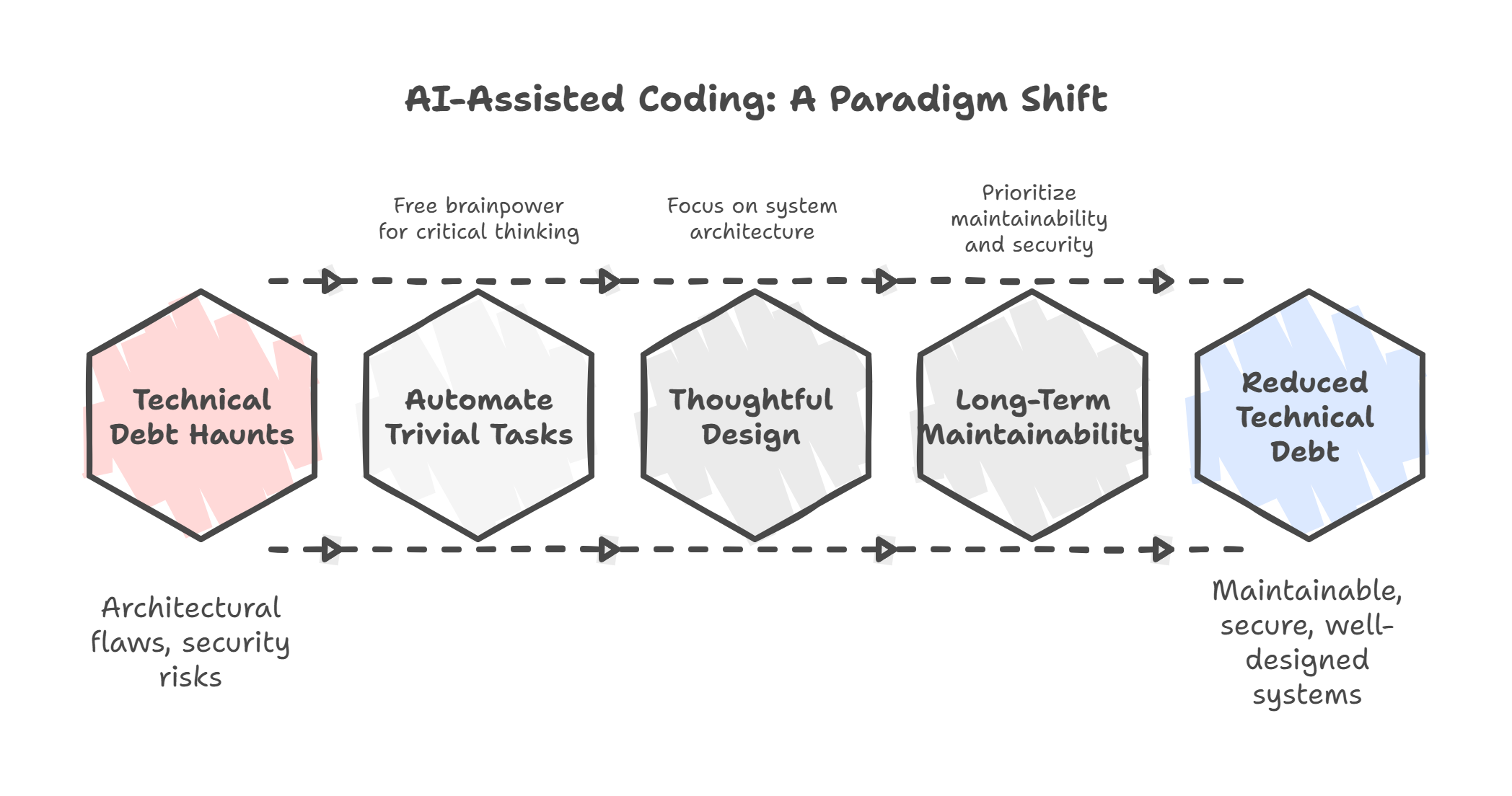
AI-assisted coding isn’t a silver bullet for technical debt. It’s a paradigm shift. It automates the trivial, freeing up human brainpower for what truly matters: thoughtful design, system architecture, and long-term maintainability. We’re trading keystrokes for critical thinking.
The ghost of technical debt hasn’t been exorcised; it has simply found a new way to haunt us. It’s less likely to be a simple bug and more likely to be a subtle architectural flaw, a hidden security risk, or a system that’s a mile wide and an inch deep. The good news is that we have more power than ever to fight it. The danger is that we have more power than ever to create it.
The ultimate outcome doesn’t depend on the AI. It depends on you. How will you and your team choose to wield this incredible new power?