
The Shiny New Tech That Went Nowhere
Let me tell you a story. It’s one I’ve seen play out in different boardrooms, with different characters, but with the same frustrating ending. A mid-sized logistics company, let’s call them „SwiftShip,“ decided it was time to ‚go digital.‘ They invested a seven-figure sum in a state-of-the-art AI-powered routing system and a slick new customer portal. The press release was glowing. The leadership team felt innovative. Six months later? The fancy AI system was being manually overridden by dispatchers who trusted their old spreadsheets more, and the customer portal had a login rate that was, to put it mildly, embarrassing. The expensive new car was sitting in the garage, keys lost, while everyone kept taking the old, reliable bus.
What went wrong? It wasn’t the technology. The software was powerful. The problem was that SwiftShip had bought a solution without ever truly understanding their problem. They had a fast car but no destination, no map, and no idea why they were even taking a trip. They had a list of technologies, not a digital transformation strategy. They had a project plan, not a roadmap.
If this scenario feels even vaguely familiar, you’re not alone. Many organizations leap at the promise of digital tools, hoping for a silver bullet. But transformation isn’t about buying technology; it’s about fundamentally rethinking how you operate and deliver value in a digital world. And for that, you need more than a shopping list. You need a guide. You need a roadmap.
First, Pin Your Destination: Strategy Before Spreadsheets
Before you even think about software, platforms, or code, you have to answer the most important question: Where are we going, and why? A digital transformation strategy isn’t an IT document; it’s a business vision. It’s a clear, compelling picture of the future state of your organization.
Forget the buzzwords for a moment. Ask yourself and your team some fundamental questions:
- What does a ‚better‘ future look like for our customers? Is it faster service, more personalized experiences, or self-service capabilities?
- How can we make our employees‘ lives easier and more productive? What friction can we remove from their daily work?
- What core business process, if we made it 10x more efficient, would unlock the most growth?
- What competitive threats or market shifts are we trying to get ahead of?
The answers to these questions form your destination. Your strategy isn’t „Implement a new CRM.“ It’s „Create a single, unified view of our customer to enable proactive support and reduce churn by 15%.“ The CRM is just a vehicle you might use to get there. This distinction is everything. It shifts the conversation from a cost-centric IT project to a value-centric business initiative.
From Vague Goals to Tangible Outcomes
A great strategy translates a broad vision into measurable business outcomes. For example:
- Vague Goal: „Improve operational efficiency.“
- Strategic Outcome: „Automate the manual order-to-cash process to reduce processing time from 3 days to 4 hours and decrease errors by 90% within 18 months.„
- Vague Goal: „Be more data-driven.“
- Strategic Outcome: „Develop a centralized analytics platform that empowers product managers to access real-time user engagement data, leading to a 20% increase in feature adoption.“
When you define your destination with this level of clarity, the path to get there—the roadmap—starts to reveal itself.
Charting the Course: The Anatomy of a Modern Digital Roadmap
If the strategy is your destination, the roadmap is your GPS. A traditional, static project plan is like a printed map from a decade ago—it’s rigid, quickly becomes outdated, and can’t react to roadblocks or detours. A modern digital roadmap is dynamic, outcome-focused, and built to adapt.
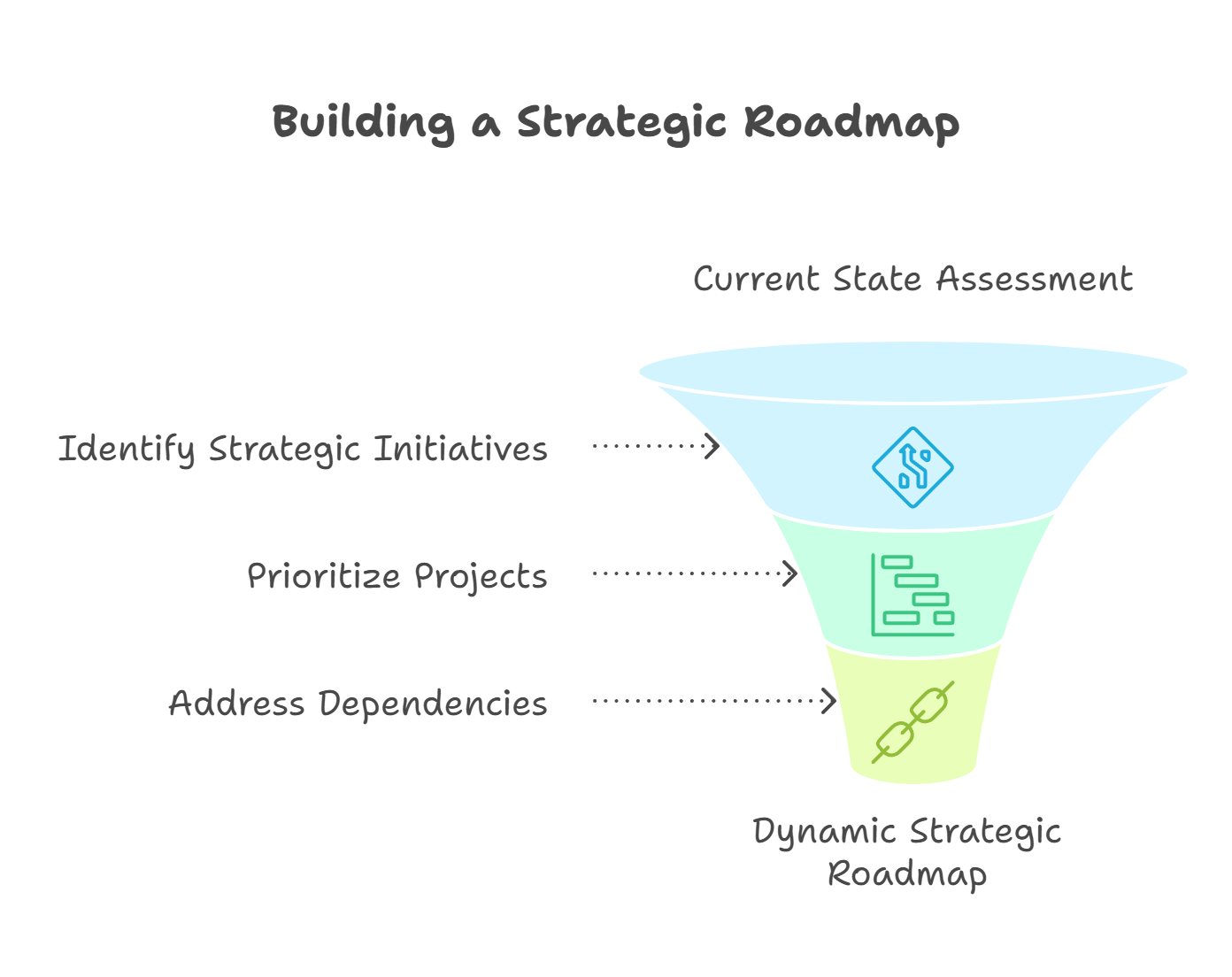
Here’s how to think about building one:
1. Know Your Starting Point (The ‚You Are Here‘ Dot)
You can’t plot a course without knowing where you are. This means a brutally honest assessment of your current state. This isn’t just about your tech stack. It’s a holistic view:
- Processes: Where are the bottlenecks? What relies on spreadsheets, email chains, and manual workarounds?
- People: What are your team’s digital skills and capabilities? Where are the gaps? Is the culture resistant to change or hungry for it?
- Technology: What systems are critical? What’s legacy tech holding you back? How well does your data flow between systems?
This audit gives you the lay of the land. You’ll identify the mountains you have to climb and the open roads you can accelerate on.
2. Identify the Major Highways (Your Strategic Initiatives)
Your roadmap isn’t a list of 100 small tasks. It’s organized around a few major, multi-quarter strategic initiatives that directly support your strategic outcomes. Think of these as the major highways you’ll be traveling on. For example:
- Initiative: Modernize Core Financial Systems
- Initiative: Enhance Customer Data & Analytics Capabilities
- Initiative: Automate Key Internal Workflows
- Initiative: Unify the Omnichannel Customer Experience
Under each of these initiatives, you can then list the specific projects or capabilities you need to build. But by grouping them this way, you ensure every project has a clear strategic purpose.
3. Sequence the Journey (Prioritization is Everything)
You can’t do everything at once. The most difficult—and most valuable—part of roadmapping is deciding what comes first. A simple but powerful tool is the Impact vs. Effort matrix. Plot your potential projects on a 2×2 grid:
- High Impact, Low Effort (Quick Wins): Do these now. They build momentum and show value early.
- High Impact, High Effort (Major Projects): These are your big, foundational transformations. Plan them carefully and break them down into phases.
- Low Impact, Low Effort (Fillers): Fit these in when you have spare capacity, but don’t let them distract you.
- Low Impact, High Effort (Time Sinks): Avoid these like the plague. They are the scenic route to nowhere.
This isn’t just a technical exercise. You also have to consider dependencies. You can’t build a sophisticated data analytics platform (a major project) if your underlying data is a chaotic mess. Cleaning up your data becomes a foundational, ‚must-do-first‘ task.
The Unwritten Rule: Transformation is a Human Endeavor
Here’s the secret that the tech vendors won’t tell you: the hardest part of digital transformation has nothing to do with technology. It has to do with people. You can have the most brilliant roadmap in the world, but if your people don’t understand it, believe in it, or know how to use the new tools, it’s just a pretty document.
As the legendary management consultant Peter Drucker said, „Culture eats strategy for breakfast.“ Your roadmap must actively account for change management. This means:
- Communicating the ‚Why,‘ Not Just the ‚What‘: Don’t just tell people you’re implementing a new system. Tell them the story. Explain how it will eliminate the tedious parts of their job, help them serve customers better, and contribute to the company’s success.
- Creating Champions: Identify influential people at all levels of the organization and involve them early. Make them part of the design and selection process. These champions will become your most effective advocates.
- Investing in Training and Support: Don’t just throw technology over the wall. Plan for comprehensive training, accessible support channels, and a grace period where mistakes are okay. The goal is adoption, not just implementation.
I once worked with a client whose first roadmap draft was 90% technology milestones. We sent them back to the drawing board. The revised version included a dedicated workstream for „Communication & Enablement“ with its own milestones, like „Host departmental town halls,“ „Launch champions network,“ and „Develop role-based training modules.“ That simple change made all the difference between a project that was *done to* their employees and a transformation that was *done with* them.
Your Roadmap is a Living Document, Not a Stone Tablet
The business world doesn’t stand still. A competitor will launch a disruptive new service. A new technology will emerge that makes your planned solution obsolete. Customer expectations will shift. If your roadmap is a rigid, five-year plan locked in a binder, you’re destined to fail.
Treat your roadmap as a living, breathing guide. Your destination—the strategic outcomes—should remain relatively stable. But the route you take to get there will almost certainly change.
Embrace agility:
- Review and Adapt Quarterly: Set up a regular cadence (at least once a quarter) to review progress against your roadmap. What have you learned? What has changed in the market? What needs to be re-prioritized?
- Focus on Themes, Not Timelines: For initiatives more than 6-9 months out, keep them at a high-level theme. Don’t waste time planning the granular details of a project you won’t start for two years. Focus your detailed planning on the immediate term.
- Celebrate Learning: If a project fails or an assumption proves wrong, it’s not a disaster; it’s data. It’s a lesson that helps you plot a better course forward. A culture that punishes failure will never innovate.
Are You Holding a Map or a GPS?
Digital transformation can feel overwhelming. It’s a journey into new and sometimes uncertain territory. But like any great journey, success starts with a clear destination and a reliable guide.
A well-crafted digital transformation strategy and roadmap do more than just plan projects. They create alignment. They force difficult conversations about priorities. They translate an abstract vision into a concrete plan of action. Most importantly, they give everyone in the organization a shared understanding of where you are going, why you are going there, and the role they play in the journey.
So, take a look at your own initiatives. Are they a disconnected list of tech projects? Or do they tell a coherent story about your future? Are you holding a dusty, old paper map, or are you navigating with a dynamic, intelligent GPS that can help you reach your destination, no matter how many detours you encounter along the way?