
The ‚Lobster Craze‘ on Your Strategy Roadmap
There’s a new buzzword making the rounds in tech circles, whispered with a mix of excitement and trepidation: OpenClaw. If you haven’t heard of it, you will soon. Sparking what’s been dubbed a „lobster craze“ in China and earning a nod from Nvidia’s Jensen Huang as potentially „the next ChatGPT,“ this open-source AI agent is the talk of the town. But unlike ChatGPT, OpenClaw isn’t just here to talk. It’s here to do.
OpenClaw promises a paradigm shift in enterprise IT: autonomous orchestration of complex workflows across ERP, CRM, and BI systems, freeing CIOs from operational details to focus on strategic steering. Imagine issuing the command: „Analyze Q1 sales data from SAP, Salesforce, and Power BI, identify anomalies, create an executive summary, and initiate approval workflows“—then attending your next board meeting, with validated outputs ready hours later. This is OpenClaw’s strategic promise: IT as a value center, not firefighting.
But for every executive dreaming of hyper-productive „virtual employees,“ there’s a CISO waking up in a cold sweat. The very thing that makes OpenClaw so powerful—its autonomy—is also what makes it terrifyingly risky. It’s the ultimate high-performance machine, a Ferrari of automation. The question for your enterprise isn’t just whether you want one, but whether you can afford to let it out of the garage. Is OpenClaw a must-have for your next strategy paper, or a liability you can’t afford to entertain?
Beyond Low-Code: What Makes OpenClaw Different?
To understand the hype, you need to grasp how OpenClaw differs from the automation tools you’re already using. Think about platforms like Zapier or n8n. They are brilliant at creating deterministic, linear workflows. If this email arrives with an invoice, then save the attachment to this folder and then send a Slack notification. It’s a predefined recipe, executed flawlessly every time.
OpenClaw doesn’t follow a recipe; it writes the cookbook on the fly. It’s designed for persistent, chained automation where the steps aren’t always known in advance. It maintains state, learns from interactions, and can decide its own course of action to achieve a goal. This is where it leaves traditional tools in the dust.
The Developer’s New Best Friend
Nowhere is this advantage clearer than in a software development workflow. A typical pull request (PR) involves a tedious, manual loop: a developer pushes code, a reviewer leaves comments, the developer makes changes, pushes again, and so on. It’s a cycle of asynchronous waiting.
OpenClaw can take over the entire process. It can be configured to:
- Scan for new PRs 24/7.
- Run a suite of tests and static analysis.
- Review the code against style guides and best practices, leaving intelligent comments.
- If tests fail, it can even attempt to debug and suggest a fix.
- Once approved, it can handle the merge, documentation updates, and ticket closure.
Each of these micro-tasks might only save 10-30 minutes, but chained together across a whole team, you’re looking at a monumental boost in development velocity. It’s the difference between a simple script and a tireless, autonomous assistant.
The Productivity Multiplier
The gains aren’t just for developers. For ad-hoc knowledge work, the results are even more dramatic. Tasks like triaging a chaotic inbox, summarizing a week’s worth of project updates, or compiling research for a report can be 5-10 times faster. While a low-code flow needs you to define the rules, OpenClaw can learn your patterns. It notices you always forward finance-related emails to accounting and starts suggesting it, eventually just doing it for you. Some agencies have reported a staggering 10x increase in output on client requests by using it to handle routine data pulling and report generation.
In China, giants like Tencent are reportedly using it to create „virtual employees“—not for core operations, but for handling the mountain of routine tasks that bog down their human counterparts. This isn’t just automation; it’s delegation to a digital entity.
The Double-Edged Sword of Autonomy
This all sounds incredible. So, what’s the catch? The catch is that the agent’s autonomy is a feature, not a bug, and that feature is fundamentally at odds with decades of enterprise IT security and compliance principles.
Security’s Worst Nightmare
For OpenClaw to perform its magic, it needs permissions. A lot of them. We’re not talking about a simple API key with a limited scope. We’re talking about system-level permissions: the ability to read and write files, execute shell commands, and interact with other applications freely. In essence, you’re giving it the keys to the kingdom.
This has led to real, documented incidents of API key theft and sensitive data leaks. It’s so serious that Chinese CERTs (Computer Emergency Response Teams) have issued warnings about takeover risks, outright banning the use of OpenClaw on standard office devices. The risk is that a cleverly crafted prompt or an exploited vulnerability doesn’t just result in a weird response; it could result in the agent executing a malicious command, exfiltrating your entire customer database, or installing ransomware.
It’s like giving an intern the root password to your production servers. Their potential for productivity is high, but their potential for catastrophic, unintentional damage is even higher.
The Compliance Conundrum
Beyond security, there’s the problem of non-determinism. For any company operating under regulations like GDPR, SOX, or HIPAA, auditability and predictability are paramount. You need to know exactly what process was followed, who approved it, and what the outcome was. OpenClaw’s unpredictable, self-directed nature shatters this model. How do you explain to an auditor that your AI agent decided on a novel, undocumented path to process sensitive customer data?
The standard enterprise solution for this kind of risk is sandboxing—running the agent in a heavily restricted environment. But this dilutes the very appeal of OpenClaw. If you have to build complex API wrappers and put every action behind a manual human approval gate, you’ve essentially neutered its autonomy and rebuilt a clunky low-code platform, defeating the entire purpose.
Finding a Place for the Ferrari: A Pragmatic Roadmap
So, is OpenClaw just a dangerous toy? Not necessarily. It’s a glimpse of the future, but it needs to be handled with the caution befitting a powerful, experimental technology. It doesn’t have to be an all-or-nothing decision. Here’s a balanced way to approach it.
1. Start in the Sandbox, and Stay There for a While
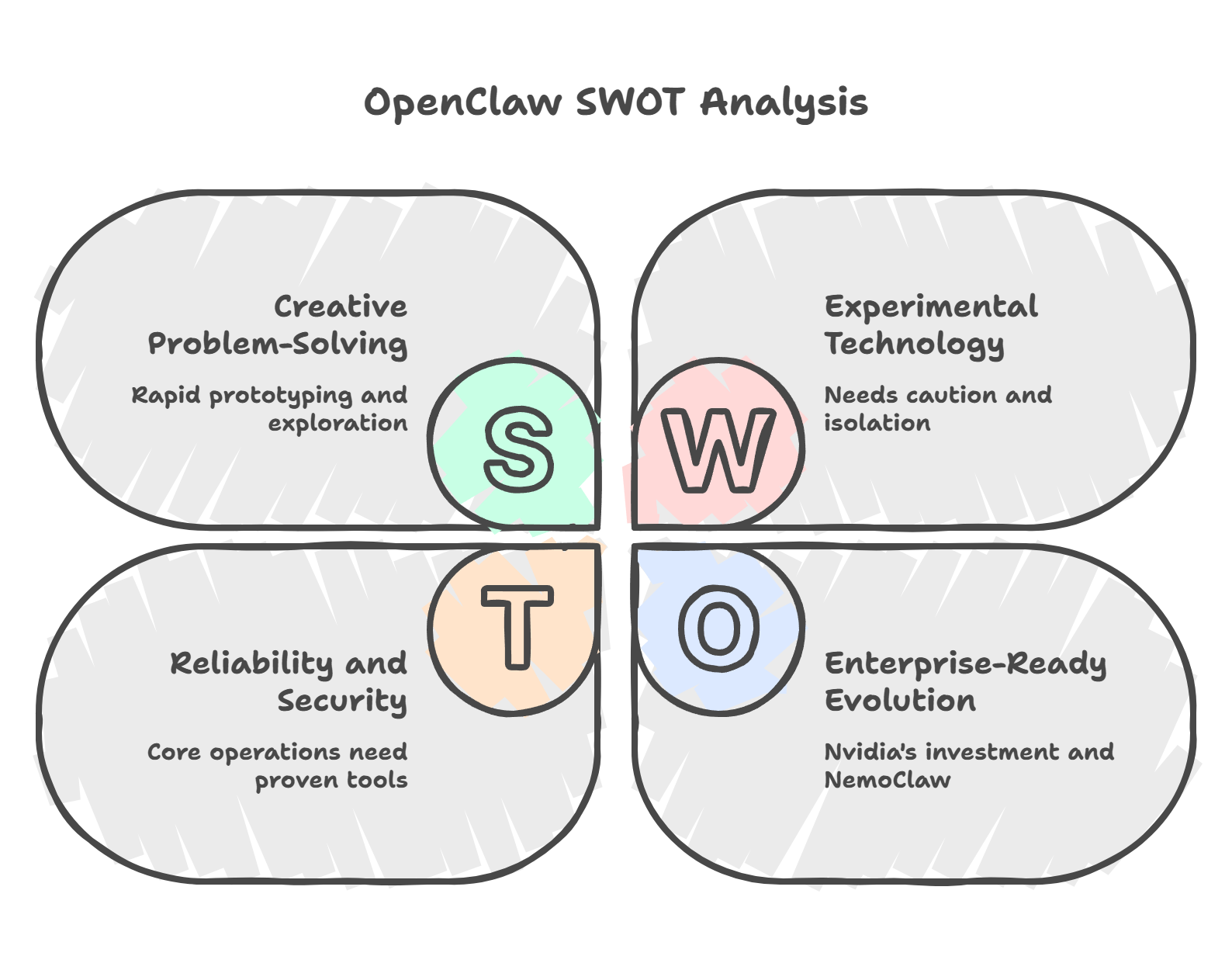
The first rule of OpenClaw is you do not connect OpenClaw to production systems. Set up a completely isolated virtual machine or container environment. Give it access only to dummy data and non-critical, API-only tools. Let your most innovative teams play with it. Let them discover what’s possible for rapid prototyping and creative problem-solving. Treat it as an R&D lab, not a production tool.
2. Embrace the Hybrid Approach
The most mature strategy is to recognize that OpenClaw and traditional automation tools solve different problems. They aren’t competitors; they are complementary.
- Use OpenClaw for what it’s good at: Prototyping, exploring dynamic workflows, and handling creative tasks where the path isn’t clear and the stakes are low. Think of it as your high-speed idea generator.
- Use Low-Code and CI/CD for your core operations: When a process needs to be reliable, auditable, and secure, stick with the proven, deterministic tools. This is your production-ready, daily driver.
This hybrid model gives you the best of both worlds—the chaotic creativity of autonomous agents and the stable reliability of established platforms.
3. Keep an Eye on the Enterprise-Ready Evolution
The industry knows these problems exist. Nvidia’s investment isn’t just about the current open-source project; it’s a bet on the underlying concept. Frameworks like Nvidia’s NemoClaw are being developed specifically to provide the necessary „enterprise hardening“—the guardrails, security layers, and logging capabilities that agents need to operate safely within a corporate environment.
The Verdict: Strategy Paper or Science Project?
OpenClaw is, without a doubt, a game-changer. It represents a fundamental shift from instruction-based automation to goal-based autonomy. For a power user or a small, agile team working in a sandboxed environment, its ability to accelerate complex, repetitive tasks is nothing short of revolutionary.
However, for the core of your enterprise operations, it remains overkill at best and a catastrophic risk at worst. The non-determinism, the setup and review overhead, and the gaping security holes make it a non-starter for anything touching critical systems or sensitive data in its current form.
So, should OpenClaw be in your enterprise strategy papers? Absolutely. But it should be in the section labeled „Research & Development“ or „Future Technology Exploration,“ not under „Q3 Production Rollout.“ The real question to ask your managers is this: Are we prepared to build the high-walled, secure sandbox needed to experiment with this powerful beast, or will we wait for a more domesticated version to arrive from the enterprise trainers?