

The Illusion of a Perfect Map
Let’s be honest. In a conference room somewhere in your organization, there’s probably a slide deck or a spreadsheet that represents the „Digital Transformation Roadmap.“ It’s meticulously planned, with color-coded swim lanes, Gantt charts stretching into 2027, and specific technologies assigned to every quarter. It looks impressive. It feels safe. And in many cases, it’s already obsolete.
We’ve been conditioned to think of strategy as a detailed, turn-by-turn set of instructions—a GPS for business. You plug in your destination, and it tells you exactly where to turn. But digital transformation isn’t a drive on a paved highway. It’s an expedition into uncharted territory. The landscape is constantly shifting, new obstacles appear overnight, and unexpected shortcuts emerge. In this world, a rigid GPS is a liability. What you really need is a reliable compass and a clear understanding of your destination, your True North.
Too many organizations are investing millions in digital initiatives that feel like motion but don’t result in progress. They’re busy, but they’re not moving closer to a transformed state. This happens when the roadmap becomes the goal, rather than the guide. It’s time to stop drawing maps of a world that no longer exists and start building a navigational capability for the one that does.
The Cartographer’s Mistake: Why Most Roadmaps Lead Nowhere
Before we can chart a better course, we have to understand the common traps that render most transformation roadmaps ineffective. It’s rarely about a lack of effort; it’s almost always about a flawed perspective from the outset.
The ‚Technology-First‘ Mirage: This is perhaps the most seductive trap. A new technology like Generative AI or the Industrial IoT emerges, and the mandate comes down: „We need an AI strategy!“ The roadmap becomes a list of technology projects in search of a problem. This is like an explorer buying a state-of-the-art submarine before deciding whether they’re exploring a mountain range or the deep sea. The technology should always be an answer to a question, not the question itself. The right question is, „What critical business capability do we need to build, and how can technology enable it?“
The Fallacy of the Five-Year Plan: In a world where entire industries are disrupted in 18 months, a highly detailed five-year plan is an exercise in fiction. It creates a false sense of security while breeding rigidity. When a new competitor or a market shift inevitably occurs, the organization faces a painful choice: stick to the beautiful-but-wrong plan, or admit the plan is worthless and start a chaotic, year-long re-planning process. The goal isn’t to predict the future perfectly; it’s to build a system that can adapt to it quickly.
The ‚Big Bang‘ Theory of Change: Another common failure mode is the belief that transformation can be accomplished in one massive, perfectly coordinated launch. This approach puts immense pressure on the organization, leading to burnout, resistance, and a high probability of spectacular failure. Real, sustainable transformation is more like building a city than launching a rocket. It happens block by block, with each new addition strengthening the foundation and informing the next step. It’s a series of deliberate, interconnected moves, not a single, all-or-nothing bet.
Finding Your True North: Crafting a Strategy That Endures
If the old way of roadmapping is broken, what’s the alternative? It starts with shifting your mindset from creating a static plan to defining a dynamic strategic framework. This framework is your compass.
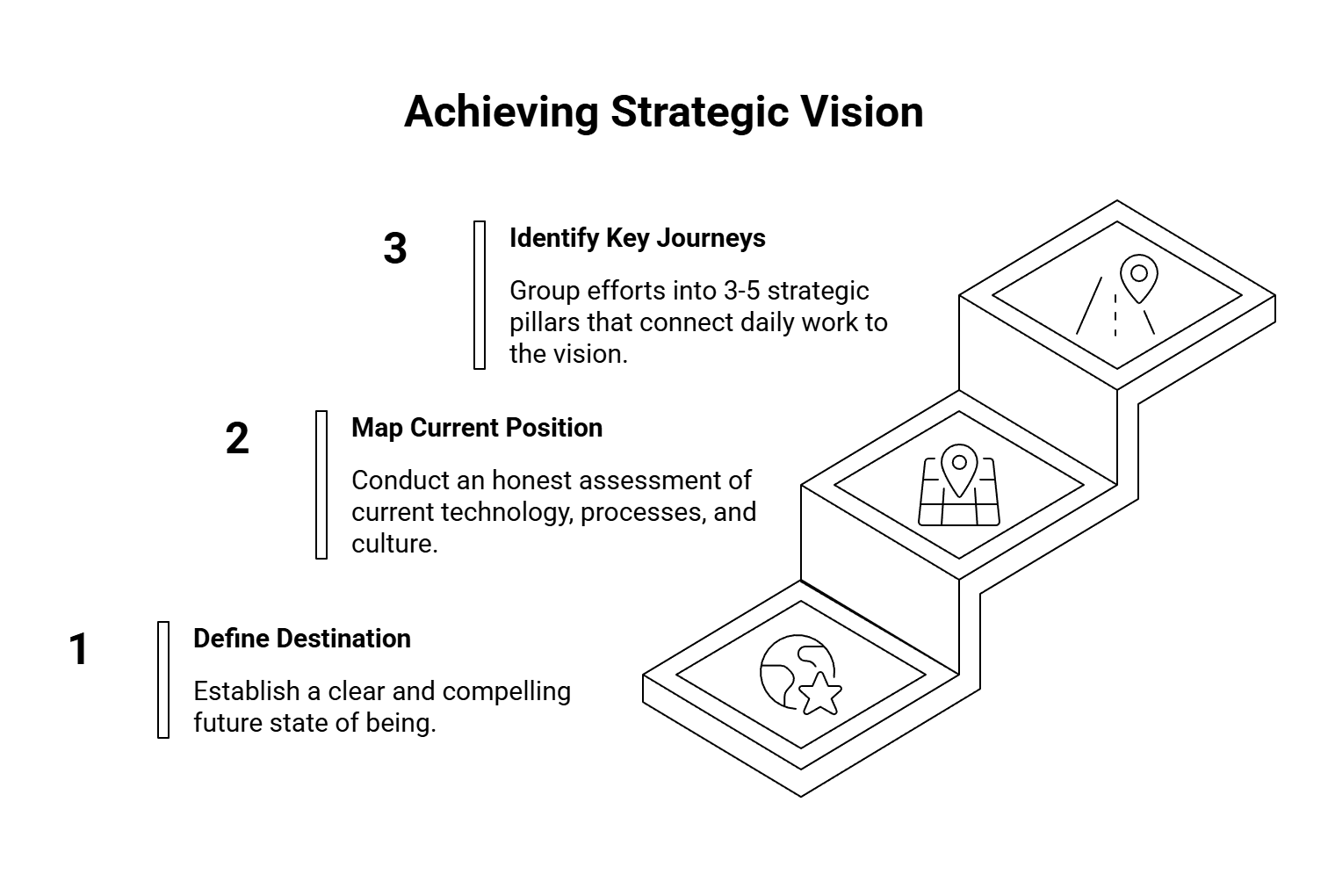
Step 1: Define Your Destination (The Vision)
Your True North isn’t a project; it’s a future state of being. It’s a clear, compelling picture of how your organization will create value for customers in a new way. It should be ambitious but understandable.
- Weak Vision: „Implement a new CRM and ERP system by 2026.“
- Strong Vision: „Become the easiest company in our industry to do business with by providing proactive, personalized support and a seamless, one-click purchasing process.“
See the difference? The first is a task. The second is a destination. It doesn’t mention specific software. It focuses on the business and customer outcome. Every single initiative on your roadmap should be justifiable as a step toward that vision.
Step 2: Map Your Current Position (The Honest Assessment)
You can’t chart a course without knowing your starting point. This requires a brutally honest assessment of your current state across three key areas: technology, processes, and—most importantly—culture.
A simple but powerful exercise is to categorize your current systems and ways of working. Think like a portfolio manager:
- Invest: What are our core strengths that we need to double down on? Where can technology create a true competitive advantage?
- Retire: What legacy systems, bureaucratic processes, or outdated mindsets are actively holding us back? Be ruthless here.
- Experiment: Where are the emerging areas where we need to place small bets to learn and explore, without committing to a massive rollout?
- Maintain: What systems are simply „keeping the lights on“ and need to be stable and efficient, but not a focus of transformation?
This assessment gives you a realistic view of the terrain you’re starting from, including the mountains you’ll have to climb and the swamps you’ll need to drain.
Step 3: Identify the Key Journeys (The Strategic Pillars)
With a destination and a starting point, you can now define the major journeys you need to undertake. Instead of a list of 100 disconnected projects, group your efforts into 3-5 strategic pillars. These pillars connect your daily work to the grand vision.
For a manufacturing company, these might be:
- Smart Factory Excellence: Using data and automation to create a predictive, efficient, and safe production environment.
- Digitally-Enabled Supply Chain: Building a resilient and transparent supply chain from raw materials to the end customer.
- Next-Generation Customer Experience: Moving from selling products to offering connected services and solutions.
Every project, from an IoT sensor implementation to a new e-commerce platform, should clearly align with one of these pillars. This prevents „rogue projects“ and ensures all your teams are rowing in the same direction.
Charting the Course: A Roadmap That Breathes
Now, we build the roadmap. But it won’t be a static Gantt chart. It will be a living document, built on the principle of progressive detailing. This is often called a horizon-based roadmap.
Horizon 1: The Trail Ahead (Now: 0-6 Months)
This is the terrain you can see clearly. Initiatives in this horizon are well-defined. They have dedicated teams, specific deliverables, clear KPIs, and detailed project plans. This is where you demand precision and accountability. You’re executing, not just planning.
Horizon 2: The Hills on the Horizon (Next: 6-18 Months)
Here, the details get fuzzier, and that’s okay. You should have clearly defined problems to solve and desired outcomes, but the specific solutions and technologies might still be flexible. This horizon is about defining the epics and features, securing funding, and doing the architectural design. You know you need to cross the hills, but you’re still deciding on the best path.
Horizon 3: The Distant Mountains (Later: 18+ Months)
This horizon is about direction, not detail. It should contain strategic themes, big questions, and capabilities you know you’ll need to build. For example, „Explore the potential of digital twins in product design“ or „Establish a decentralized data governance model.“ It’s a placeholder for future exploration, ensuring you don’t lose sight of the long-term destination while navigating the immediate trail.
Governance: The Rudder for Your Ship
This living roadmap is useless without a mechanism to steer it. That’s governance. But forget the slow, bureaucratic approval boards of the past. Modern transformation governance is a nimble steering committee—a cross-functional group of business and tech leaders who meet frequently (perhaps bi-weekly or monthly). Their job isn’t to micromanage projects. It’s to:
- Check the Compass: Are we still heading toward our True North?
- Scan the Horizon: Has the competitive landscape or technology environment changed?
- Make Course Corrections: Based on new information, should we accelerate an initiative, pivot, or even cancel one?
- Allocate Resources: Shift funding and people to where they can create the most value now.
This group provides the essential link between the long-term strategy and the short-term execution, allowing the organization to adapt without losing its way.
The Expedition Crew: It’s Always About the People
We can draw the most beautiful maps and have the most advanced compass, but an expedition’s success ultimately depends on its crew. Digital transformation is fundamentally a human challenge, not a technical one. It asks people to change the way they work, think, and collaborate.
Your strategy and roadmap must explicitly account for this. Don’t just plan for software rollouts; plan for change management, communication, and training. Tell the story of the destination constantly. Explain the why behind the changes, not just the what. Celebrate the small wins along the way to build momentum and prove that the journey, while difficult, is worth it.
Ultimately, a successful transformation doesn’t just install new technology; it builds new muscles in the organization—muscles of agility, data literacy, customer-centricity, and resilience. The final destination of your roadmap isn’t a finished set of projects. It’s an organization that has learned how to navigate change itself.
So, take another look at your roadmap. Is it a rigid set of instructions from a world that’s already gone? Or is it a compass, empowering your teams to confidently explore the future? The answer will determine whether you simply arrive at a destination or build an organization capable of any journey.