
The Procurement Treadmill
Let’s be honest for a moment. Does your IT procurement process feel less like a strategic function and more like a hamster wheel? A frantic scramble for quotes when a renewal pops up. An endless cycle of RFPs that consume weeks of effort, only to focus almost exclusively on the lowest upfront cost. A new piece of software is onboarded, and then… silence. The vendor relationship goes dark until the next invoice or renewal panic 90 days out.
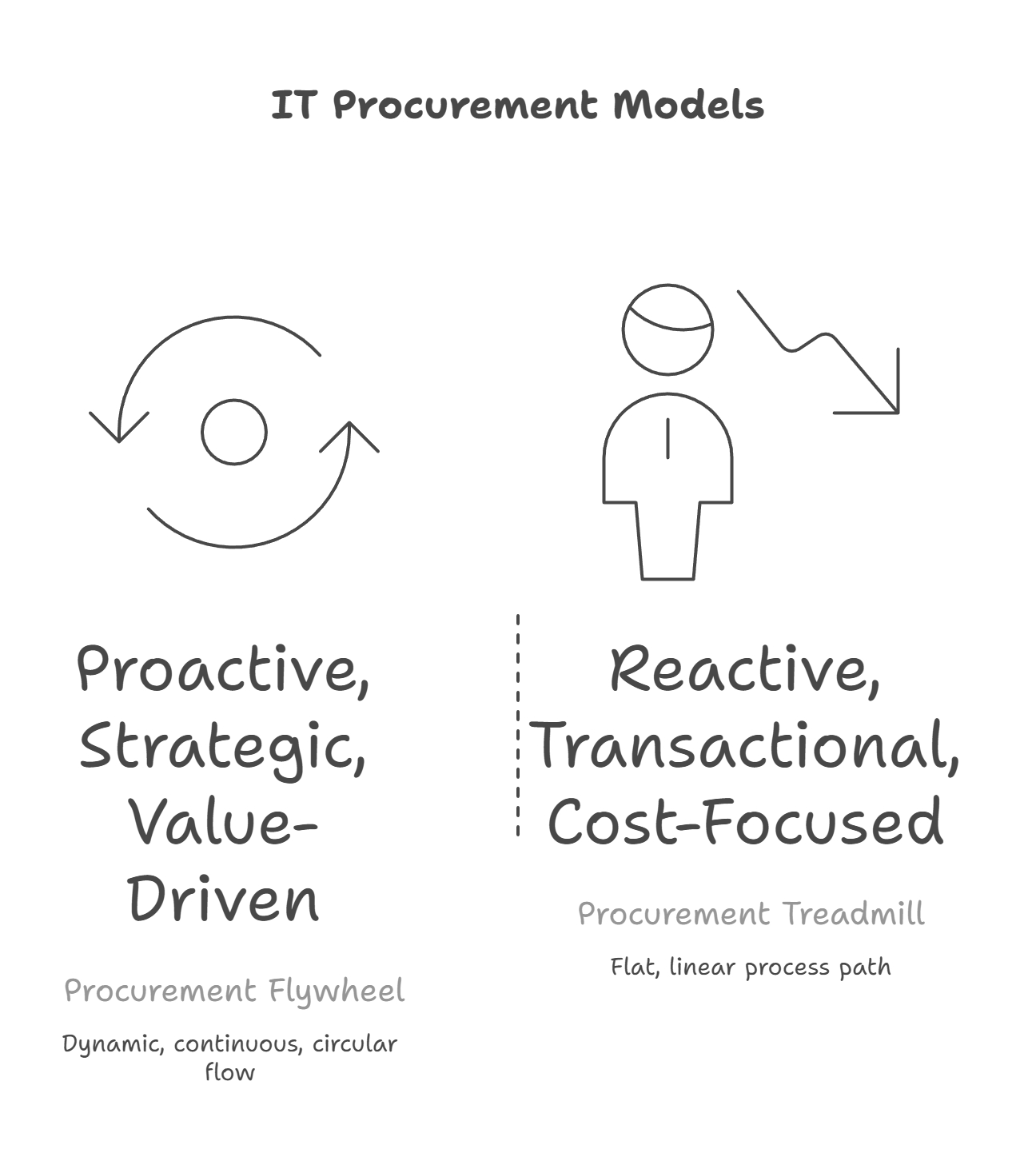
If this sounds familiar, you’re not alone. For decades, IT procurement has been stuck in a linear, transactional model: Need -> Source -> Negotiate -> Sign -> Forget. This approach treats technology as a commodity and vendors as interchangeable parts. In today’s hyper-connected, SaaS-driven world, that model isn’t just outdated; it’s a significant business risk. It leads to shelfware, surprise costs, vendor lock-in, and missed opportunities for innovation.
But what if you could break the cycle? What if you could transform your procurement process from a reactive treadmill into a proactive, self-optimizing flywheel? A system where every action, every decision, and every relationship builds momentum, making the entire ecosystem smarter, more resilient, and more valuable over time. It’s time to move beyond the RFP and start building your IT Procurement Flywheel.
Deconstructing the Broken Linear Model
Before we build the new model, we have to understand why the old one fails. The traditional, linear procurement path is riddled with value leaks at every stage. It’s a process designed for buying widgets, not for building strategic technology partnerships.
Think about the last major software purchase you made. The business identified a need, you spent a month crafting a 50-page RFP, and three vendors responded. You created a giant spreadsheet comparing features, ticking boxes. The decision likely came down to a few percentage points on price. You signed a three-year deal, handed it off to the implementation team, and moved on to the next fire.
What was missed? You probably didn’t deeply evaluate the vendor’s product roadmap and how it aligns with your company’s three-year strategy. You might not have considered the total cost of ownership (TCO), including the hidden costs of integration, training, and internal support. And crucially, you established a purely transactional relationship. The vendor’s job was to deliver on the contract, and your job was to pay the bill. There was no built-in mechanism for co-innovation, continuous improvement, or strategic alignment.
This is how you end up with a portfolio of expensive tools that don’t talk to each other, frustrated users, and a nagging feeling that you’re not getting the full value from your massive tech spend.
Introducing the IT Procurement Flywheel: A Virtuous Cycle
A flywheel, in mechanical terms, is a device that stores rotational energy. It takes a lot of effort to get it moving, but once it’s spinning, it maintains its momentum and becomes easier to accelerate. The IT Procurement Flywheel applies this concept to your vendor and technology management.
It’s a continuous, four-stage cycle where the output of one stage becomes the input for the next, creating a self-reinforcing loop of improvement. The stages are:
- Strategic Sourcing & Market Intelligence: Proactively understanding the market and aligning technology possibilities with long-term business goals.
- Holistic Evaluation & Onboarding: Choosing partners based on total value, not just initial cost, and ensuring a smooth, successful integration into your ecosystem.
- Continuous Performance & Relationship Management: Actively managing partnerships post-contract to maximize value, drive innovation, and mitigate risk.
- Data-Driven Optimization & Renewal: Using hard data and performance insights to make smart decisions about contract renewals, consolidations, or replacements.
Let’s break down how to get each part of the flywheel spinning.
Stage 1: Strategic Sourcing – The Intelligence Engine
This is where you stop being a reactive shopper and become a market analyst. Instead of waiting for a business unit to hand you a request, you’re already one step ahead. Your goal is to build a deep understanding of the technology landscape relevant to your industry and business strategy.
How to get it spinning:
- Build a ‚Vendor Radar‘: Actively track emerging players, disruptive technologies, and market trends in your key tech categories (e.g., cybersecurity, data analytics, CRM). Use sources like Gartner, Forrester, industry news, and even venture capital funding announcements.
- Hold ‚Future-State‘ Workshops: Meet with business leaders before they have an urgent need. Discuss their goals for the next 18-24 months and brainstorm how emerging technology could help them get there. You’re not selling a solution; you’re co-creating a technology roadmap.
- Engage Pre-RFP: Cultivate relationships with a diverse range of potential vendors. Have introductory calls to understand their vision and capabilities long before you need them. This gives you a richer pool of options when a need does arise and shortens the sourcing cycle.
Stage 2: Holistic Evaluation – The Value Architect
When a specific need materializes, the flywheel model demands you evaluate potential partners on more than a feature-for-feature checklist. You’re assessing their long-term fit within your entire technology ecosystem.
How to get it spinning:
- Look Beyond the Demo: Ask tough questions. How robust are their APIs for integration? What is their security posture, and can they provide third-party audit reports (like a SOC 2)? What does their customer support model really look like? Talk to reference customers about their onboarding and post-sales experience.
- Calculate True TCO: Go beyond the license fee. Factor in implementation costs, data migration, required training for your team, ongoing administrative overhead, and potential integration expenses. An apparently cheaper solution can often have a much higher TCO.
- Assess Cultural Fit: This sounds soft, but it’s critical for a strategic partnership. Is the vendor’s team collaborative and responsive? Do they listen to feedback? A difficult-to-work-with partner can poison a project, regardless of how great their tech is.
Stage 3: Continuous Management – The Partnership Cultivator
This is the heart of the flywheel and the stage most often neglected in the traditional model. The contract being signed is the start of the relationship, not the end of the project. This is where you extract the ongoing value.
How to get it spinning:
- Implement a Modern Vendor Scorecard: Ditch the simple red/yellow/green SLA tracker. Create a scorecard that measures what truly matters. Include metrics like:
- Business Impact: Did the solution help decrease customer churn by X% or improve marketing lead conversion by Y%?
- Adoption & Usage Rates: Are people actually using the tool you’re paying for?
- Innovation Contribution: How many proactive suggestions or valuable new features has the vendor brought to the table?
- Relationship Health: A qualitative score based on feedback from your internal teams about collaboration and responsiveness.
- Reinvent the QBR: Transform your Quarterly Business Reviews from a complaint session into a forward-looking strategic meeting. The agenda should focus 50% on performance and 50% on the future. What’s on their roadmap? What are your upcoming business initiatives? How can you work together to achieve those goals?
Stage 4: Data-Driven Optimization – The Ecosystem Gardener
This final stage is where the momentum truly builds. You take all the data and insights gathered from the Continuous Management stage and use it to make intelligent, proactive decisions. This feeds directly back into your Strategic Sourcing efforts, making the entire process smarter.
How to get it spinning:
- Master Renewal Management: Your renewal process should start 6-9 months out, not 90 days. Armed with your scorecard data, you know exactly how valuable the partnership is. Are usage rates low? You have leverage to renegotiate the seat count. Is the business impact minimal? You have time to evaluate alternatives without being rushed.
- Tackle SaaS Sprawl: In a world with hundreds of SaaS apps, redundancy is rampant. Use this stage to actively rationalize your portfolio. Are you paying for three different project management tools? Use performance and adoption data to choose a single standard, consolidate licenses, and reduce both cost and complexity.
- Feed the Intelligence Engine: Did a vendor perform exceptionally well? They become a preferred partner for future projects. Did a technology category prove to be more complex than expected? That insight informs your next evaluation process. Every contract end-date is a chance to learn and refine your overall strategy.
Putting It All Together: Your First Spin
Building a fully functional IT Procurement Flywheel doesn’t happen overnight. It’s a cultural and procedural shift. But you can start today. Pick one area to focus on. Maybe it’s redesigning your vendor scorecard for your top five most critical suppliers. Or perhaps it’s scheduling your first ‚Future-State‘ workshop with the marketing department.
By moving from a linear, fragmented process to an integrated, continuous cycle, you change the very nature of your role. You’re no longer just a cost-cutter or a contract administrator. You are a strategic architect of your organization’s technology ecosystem, a driver of innovation, and a crucial partner in achieving business goals.
The treadmill is exhausting, and it leads nowhere new. The flywheel takes effort to start, but its momentum will carry your organization forward. So, what’s the one push you can make today to get your flywheel spinning?