
The Illusion of Control in a Sea of Spreadsheets
Picture this: a quarterly portfolio review meeting. The air is thick with the smell of lukewarm coffee and quiet tension. A senior project manager is clicking through a 75-slide deck, a kaleidoscope of Gantt charts, RAG statuses, and budget burn-down graphs. On paper, everything looks… fine. Milestones are being met, budgets are mostly in check. Yet, everyone in the room feels a low-grade hum of anxiety. They know the reality behind the charts: teams are stretched to the breaking point, key developers are being pulled in five different directions, and the ’synergy‘ between Project A and Project B is a polite fiction. The projects are succeeding individually, but the system is failing collectively.
If this scene feels uncomfortably familiar, you’ve experienced the fundamental challenge of enterprise-level project management. It’s not about scaling up what works for a single project. It’s an entirely different discipline. Managing a single project is like building a house; managing an enterprise portfolio is like being the chief architect and city planner for a sprawling metropolis. You’re not just concerned with one structure; you’re responsible for the power grid, the water supply, the transportation networks, and the zoning laws that allow the entire system to function and grow sustainably.
Too often, we try to manage the metropolis with the blueprint for a single house. We focus on individual project execution while ignoring the foundational infrastructure that enables—or cripples—all projects. It’s time to shift our perspective from project *manager* to enterprise *architect*. Let’s explore the unspoken rules and foundational blueprints that separate chaotic, fire-fighting organizations from those that build resilient, successful project ecosystems.
The Governance Fallacy: From Rigid Gatekeeper to Wise Gardener
When you hear „project governance,“ what comes to mind? For many, it’s a bureaucratic Project Management Office (PMO), armed with complex forms, rigid stage-gates, and the power to say „no.“ This traditional view of governance is rooted in control and compliance, acting as a gatekeeper to protect the organization from risky projects. But in today’s fast-paced environment, a rigid gatekeeper often becomes a bottleneck, stifling innovation and frustrating teams.
A modern, effective enterprise PMO acts less like a gatekeeper and more like a wise gardener. A gardener doesn’t force a seed to grow by yelling at it. They cultivate the environment: they ensure the soil is fertile (providing the right tools and templates), pull the weeds (remove systemic blockers), and make sure each plant gets the right amount of sun and water (strategic resource allocation). They understand that a delicate flower doesn’t need the same support as a giant oak tree.
Cultivating Your Project Ecosystem
So, how do you make this shift? It starts with adaptive governance.
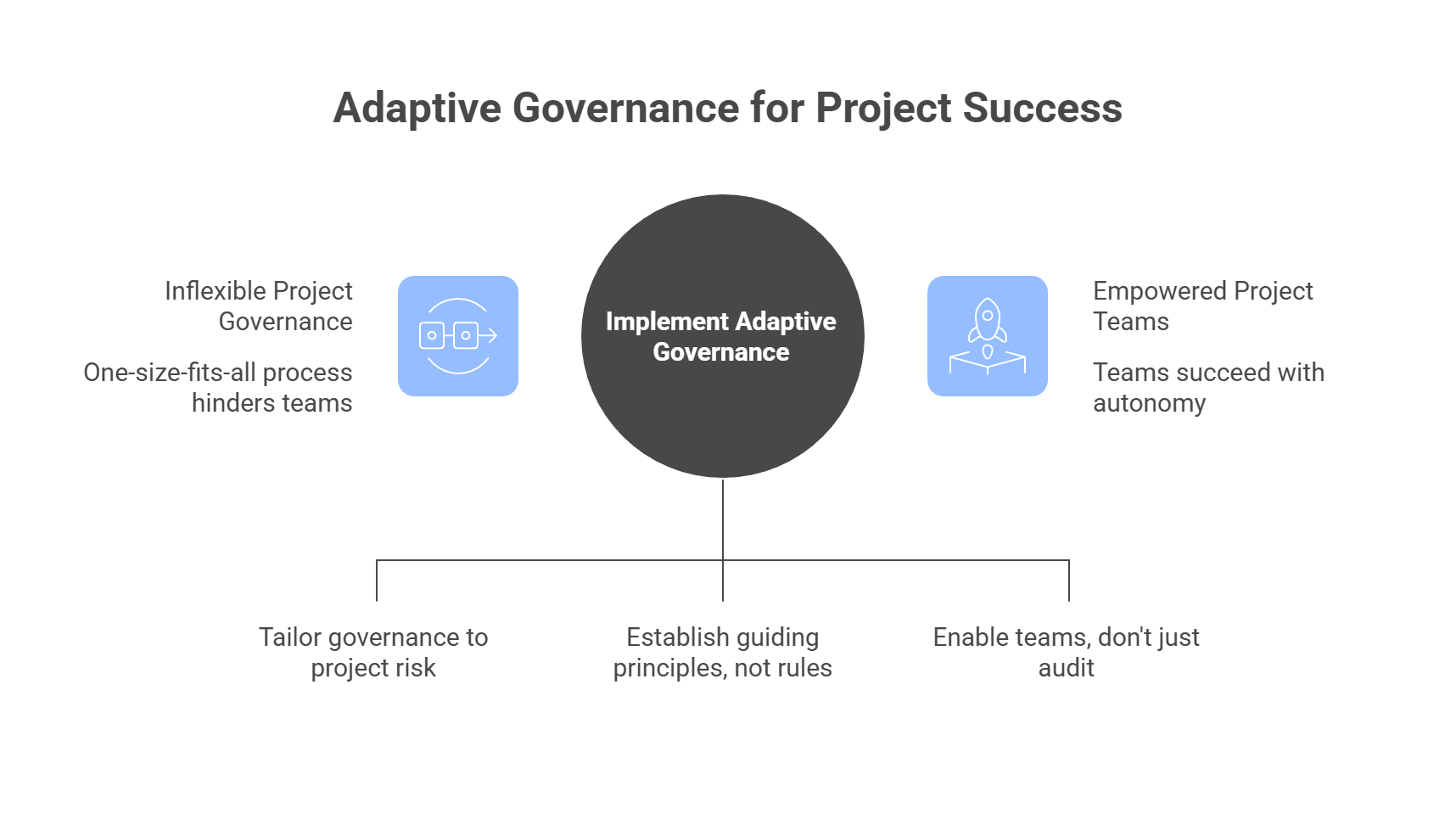
- Tier Your Processes: Not all projects are created equal. A multi-million dollar, cross-functional platform migration shouldn’t follow the same process as a three-week marketing campaign optimization. Create a tiered system. Tier 1 projects (high risk, high investment) get the full, robust governance treatment. Tier 3 projects (low risk, small team) might only require a simple brief and a lightweight retrospective. This frees up your most valuable resource: your teams‘ time and focus.
- Focus on Principles, Not Police Actions: Instead of a 100-page rulebook, establish a set of guiding principles. For example, a principle might be „All projects must have a clearly identified business owner who is accountable for outcomes.“ How a team achieves that might vary, but the principle is non-negotiable. This empowers teams with autonomy while ensuring strategic alignment.
- The PMO as a Service Center: Reframe the PMO’s mission from ‚enforcement‘ to ‚enablement.‘ Their job is to make it easier for project teams to succeed. They should be a center of excellence, offering coaching, providing battle-tested templates, and facilitating cross-team communication, not just auditing status reports.
The Myth of 100% Utilization: Mastering Strategic Capacity Planning
Here’s the most dangerous lie in enterprise project management: that your key people are 100% available for project work. In reality, their time is fragmented by business-as-usual tasks, administrative overhead, unplanned fire-drills, and endless meetings. According to research, the average knowledge worker is interrupted every 11 minutes, and it can take over 20 minutes to refocus. This context-switching is a silent killer of productivity.
At the enterprise level, your most critical, finite resource isn’t your budget; it’s the focused time of your most skilled people. Yet, most organizations manage this resource with wishful thinking and overloaded spreadsheets. True enterprise-level success requires a shift from project-level resource allocation to enterprise-level capacity planning.
Seeing the Whole Picture
This means getting brutally honest about your organization’s true capacity. You need a centralized, holistic view of not just who is working on what, but what their realistic availability is. A senior engineer isn’t a resource you can schedule for 40 hours a week on your project; after you account for their role in mentoring, production support, and internal guilds, you might only have 15-20 hours of their focused project time. Acknowledging this reality is the first step.
The next step is strategic portfolio balancing. With a clear view of capacity, you can engage in ‚what-if‘ analysis. What is the impact on our engineering capacity if we approve the new data warehousing initiative this quarter? If we delay the marketing automation upgrade, can we accelerate the launch of our new mobile feature? These are the real strategic conversations that EPM should facilitate. It’s about making deliberate trade-offs based on a realistic understanding of your constraints, rather than overloading the system and hoping for the best.
The Communication Cascade: Engineering the Flow of Information
We all know communication is important. But at the enterprise scale, it’s not just about sending a weekly status report. It’s about designing an information architecture that ensures the right message, with the right context, reaches the right audience, at the right time. I call this the „communication cascade.“ A tiny ambiguity at the executive level—a casual comment in a steering committee meeting—can cascade down through the organization, getting misinterpreted at each level until it becomes a massive execution error on the front lines.
I once saw a multi-million dollar project go off the rails because of this. The executive sponsor mentioned they wanted to „leverage AI“ in the new platform. To them, it was a high-level, aspirational goal. By the time that message reached the development team, it had been translated into a hard requirement to build a complex, custom machine learning model, delaying the project by six months. A well-designed communication plan could have prevented this.
From Reports to Narratives
An effective communication architecture distinguishes between reporting and narrative.
- Reporting is the ‚What‘: These are the dashboards, the metrics, the RAG statuses. They provide data and are essential for project managers and teams to track progress.
- Narrative is the ‚So What‘: This is the story you tell about the data. It’s for leadership and stakeholders. They don’t need to know every task that’s behind schedule. They need to know: „We are seeing a two-week delay in the integration module due to an unexpected issue with a vendor’s API. Here is our mitigation plan, here is the impact on the go-live date, and here is the decision we need from you.“
Your job as an enterprise architect is to define these communication pathways. Who is responsible for translating the data into a narrative? How often do steering committees meet, and what is the exact format of the information they receive? How are decisions documented and cascaded back down to the teams? Engineering this flow is just as critical as engineering the product itself.
The Tooling Trap: Why a Fool with a Tool is Still a Fool
A common response to enterprise project chaos is to buy a big, expensive, all-in-one Enterprise Project Management (EPM) software suite. The sales pitch is seductive: a single source of truth, automated reporting, seamless resource management! The reality? Many organizations spend millions on a sophisticated tool only to find it has automated their existing bad processes, creating a more efficient form of chaos.
Technology is an amplifier. It will amplify good processes and discipline, and it will amplify confusion and dysfunction. The tool is not the solution; it is an enabler for your solution. You must define your philosophy and processes for governance, capacity planning, and communication *first*. Only then can you configure a tool to support that philosophy.
When evaluating technology, don’t start with features. Start with your pain points. Are teams struggling with visibility into dependencies? Is resource planning your biggest nightmare? Let the problems guide your search. And prioritize integration above all else. An EPM tool that doesn’t talk to your finance system (for budget tracking), your HR system (for people data), and your development tools (like Jira or Azure DevOps) will forever be an isolated silo, never a true enterprise solution.
Building Your Blueprint
Stepping back from the day-to-day project firefights to think like an architect is a profound shift. It’s about recognizing that the long-term health of your organization’s delivery capability depends not on the heroic efforts of individual project managers, but on the strength and intelligence of the underlying system you build.
It means moving from policing to cultivating with your governance. It means treating your people’s time as the precious, finite resource it is. It means deliberately designing how information flows, not just hoping it gets to the right place. And it means letting your process and culture lead your technology choices, not the other way around.
So, take a look at your own organization’s ‚city plan.‘ Which part of your enterprise project blueprint needs the most attention right now? Is it the crumbling foundation of your governance, the overloaded power grid of your resource capacity, or the patchy signal of your communication network? The first step to building a more resilient system is knowing where to lay the first stone.